How Much Does French Drain Installation Cost in Orlando
National pricing guides don't account for Central Florida's flat lots, hardpan soil, and permit requirements. Here's what licensed local contractors actually charge.

How Much Does French Drain Installation Cost in Orlando
National pricing guides don’t account for Central Florida’s flat lots, hardpan soil, and permit requirements. Here’s what licensed local contractors actually charge.
If you’ve spent a summer watching water pool against your garage slab or your backyard turn into a temporary lake after every afternoon storm, you already understand the Central Florida drainage problem. What you may not understand yet is how much fixing it costs—or why the $1,500–$8,000 national averages on Angi or HomeAdvisor have almost nothing to do with what a licensed contractor in Orange County will quote you.
Orlando averages 53.7 inches of rain per year. June and July alone deliver 7.5 and 7.4 inches respectively, per National Weather Service data. That’s structural engineering problem territory, not a seasonal inconvenience. The flat, clay-heavy lots of post-2000 subdivisions in Horizon West, Lake Nona, and MetroWest are poorly equipped to handle it. A drainage flaw that’s barely visible in April becomes a foundation risk, a garage flood, or an eroded swale by midsummer. Getting ahead of that window—and doing it correctly once—requires understanding what a properly engineered French drain installation actually costs here, what complications drive that cost up, and what permit and HOA requirements you’ll need to clear before anyone puts a shovel in the ground.
This guide is built specifically for Orange County homeowners. Not repurposed from national data.
What French Drain Installation Actually Costs in the Orlando Market
Editor’s note: The price ranges in this section are drawn from contractor reporting and on-the-ground market data specific to the Central Florida market. Readers should obtain multiple bids from licensed contractors before budgeting for any project.
Most Orange County homeowners looking at a legitimate French drain installation should budget higher than the national guides suggest. The reasons are specific. Here’s what the tiers look like in the current Central Florida market:
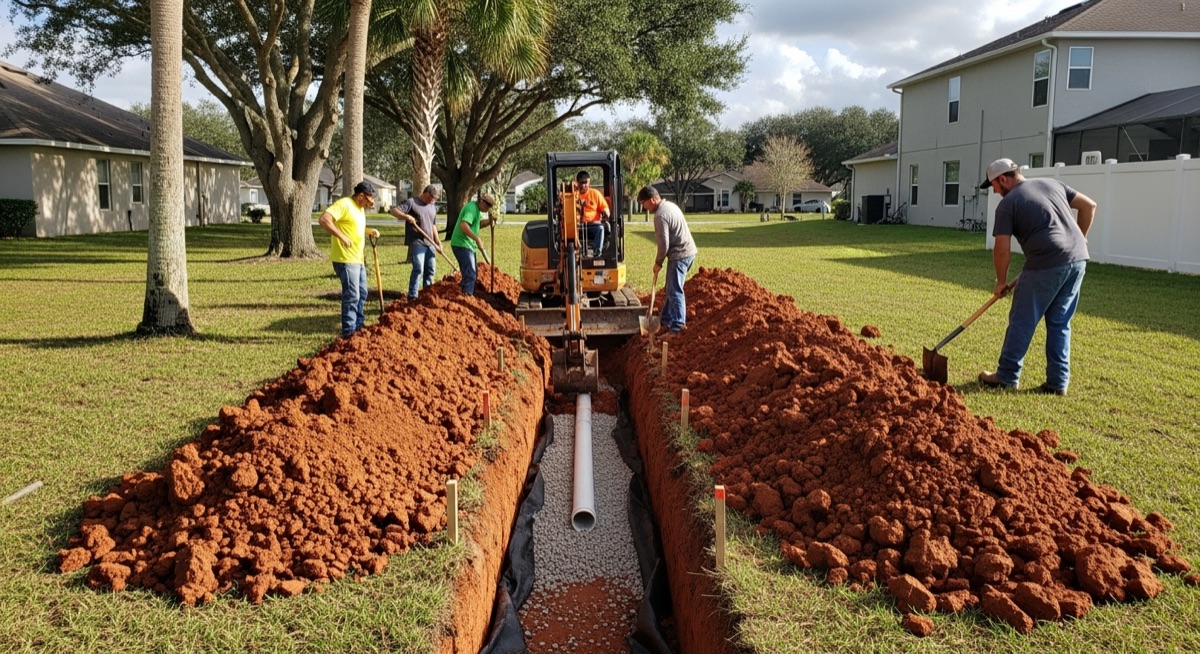
Basic installation (50–75 linear feet, straightforward residential lot): $2,500–$4,500. This includes a single-trench French drain with perforated pipe, filter fabric wrap, gravel backfill, and a defined outfall. It’s appropriate for a lot with manageable slope, reasonable soil conditions, and a clear, legal termination point. Think older College Park, Baldwin Park, or Thornton Park properties, where the soil is more cooperative and the existing topography actually gives contractors something to work with—a refreshing change from the engineered flatness of newer subdivisions.
Mid-complexity system (catch basin, regrading, or multiple drain runs): $4,500–$8,000. Most newer suburban homeowners land here, whether they expect to or not. A catch basin—the surface inlet that captures standing water before directing it underground—adds $800–$1,500 per unit in materials and labor. If the grade needs correction before the drain can function properly, regrading adds further cost. Lots in Avalon Park, Conway, and MetroWest (ZIP 32835) commonly fall in this tier.
Full perimeter or foundation drainage system: $8,000–$15,000 and up. This covers homes with drainage problems around the foundation perimeter. Slab-on-grade construction in Lake Nona and Horizon West falls here—systems must encircle or partially encircle the structure, run deeper to clear hardpan layers, and terminate into a retention area or right-of-way swale with proper engineering. Multi-outlet systems or those requiring an engineered outfall plan will reach the top of this range or exceed it.
Licensed crew labor in Orange County runs $65–$95 per hour. Drainage work requires sustained excavation, precise grading judgment, and on more complex jobs, the contractor’s professional license. The difference between a licensed crew and whoever answered a Craigslist ad shows up five years from now, when one system is still working and the other has undermined a neighbor’s fence line.
Excavation depth is the variable most homeowners underestimate—and the one that most frequently blows up a budget. A standard French drain trench might run 18 inches deep in favorable soil. In Horizon West, Lake Nona, and other post-2000 subdivisions built on former agricultural or wetland land, the hardpan clay layer commonly sits 18–36 inches below the surface. You need to penetrate it to reach more permeable soil beneath. That means 24–36 inch trenches, more excavation time, more material removal, and sometimes equipment a smaller crew simply doesn’t own.
Outfall engineering is frequently the most legally and technically complicated part of the job—and the part most contractors’ websites don’t discuss. If your outfall terminates in a public right-of-way swale, a retention pond, or any shared drainage infrastructure, you’re likely looking at a permitted connection that requires design drawings and inspection. That adds cost in both fees and contractor time.
Why Orlando’s Soil and Terrain Drive Up Installation Complexity
The phrase “flat Florida lot” actually understates the engineering challenge. Orange County residential lots built after 2000 in master-planned subdivisions often have less than 12 inches of total elevation change across 50 linear feet of yard. French drains require a minimum 1% grade to function through gravity—a 6-inch drop per 50 feet. On some lots, that minimum is barely achievable. On others it isn’t achievable at all without regrading first, which adds cost before the drain itself is ever installed.
Central Florida’s geology is not uniform, and that matters more than most homeowners realize.
Post-2000 subdivisions in Horizon West (ZIP 34787), Lake Nona (ZIP 32827), and Avalon Park (ZIP 32828) were largely developed on land with heavy clay and hardpan layers close to the surface—a byproduct of land clearing, construction compaction, and the underlying geology of former wetland or agricultural areas. Soil in MetroWest (ZIP 32835) and parts of Conway (ZIP 32812) presents similar challenges. Water doesn’t percolate down quickly through this soil. It hits the clay layer, spreads laterally, and has nowhere to go. A French drain that only reaches 18 inches down doesn’t solve anything; it terminates above the layer that needs to be penetrated. Contractors who’ve actually worked these neighborhoods know to specify 24–36 inch trench depths. That additional depth is a legitimate cost driver, not padding.
Older urban neighborhoods operate differently. College Park, Baldwin Park, Thornton Park, parts of Winter Park—developed on naturally sandy loam or better-draining soils that predate the mass grading of modern subdivisions. French drain installations here are typically shallower and less expensive. If you’re in one of these neighborhoods and getting quotes that sound high, ask your contractor specifically about soil depth and whether the trench specification actually reflects your lot conditions. It’s a fair question, and a good contractor won’t bristle at it.
The Orange County Soil and Water Conservation District offers free technical assistance that can tell you exactly what you’re working with before you spend a dollar on contractor visits. Get that information early. This kind of prep work is the sort of practical detail we track in our home & property coverage because it consistently saves Orlando homeowners money before the first contractor call.
Permits: What Orange County Actually Requires Before You Dig
The permit requirements described here reflect publicly available Orange County code and policy. Before starting any drainage project, verify current requirements directly with the Orange County Building Division (407-836-5550) and Public Works/Stormwater Management (407-836-7900), as requirements may have changed.
Many homeowners assume they can install a French drain as a straightforward yard improvement without involving the county. Sometimes that’s correct. The threshold for when a permit is required is more specific than most national guides acknowledge—and the consequences of getting it wrong are real.
Under Orange County’s Land Development Code (Section 34), a Site Drainage Permit is required when the outfall of a drainage system reaches a public right-of-way, a roadside swale, or a shared retention area. This is the most common scenario for homeowners whose properties drain toward the street or toward community retention infrastructure. You cannot legally connect without a permitted outfall design. A contractor who tells you otherwise is creating liability for both of you. No exceptions.
A straightforward interior-lot installation might be permit-exempt—say the French drain captures water from a low point in your backyard and directs it to a downhill corner of your own property, terminating in a dry well or dispersal area that stays on your land. But this requires that the outfall genuinely stay on your property and not affect neighboring lots, which is harder to guarantee than it sounds on a quarter-acre lot with 8 inches of total grade change.
One more thing worth stating plainly: under Florida law, redirecting stormwater onto a neighboring property is illegal. It creates civil liability, and drainage disputes between neighbors are among the more common property litigation matters in Orange County. A properly designed system defines exactly where water goes, and that termination point must be legal. A contractor who waves this off is not someone you want managing your drainage.
Permit fees for residential drainage work in unincorporated Orange County run approximately $75–$250 depending on project scope. Confirm whether permit fees are included in the bid or billed separately—some contractors bundle them, some don’t, and the invoice surprise is avoidable.
If you live in an incorporated municipality, the process changes entirely. Winter Park, Maitland, Windermere, and other incorporated cities within Orange County operate their own building and drainage permit requirements, which may differ significantly from county standards. Contact your city’s building or community development department directly. Do not assume Orange County’s requirements apply to your address if you’re within incorporated city limits. This is one of those details that’s easy to get wrong and annoying to correct mid-project.
HOA Approval: The Compliance Layer No National Guide Addresses
If your neighborhood was platted as part of a master-planned development in Dr. Phillips, Horizon West, Windermere, or similar communities, there’s a good chance that any drainage modification to your property requires Architectural Review Committee (ARC) approval before work begins—independent of any county permit. This is the part that surprises people.
Most HOA CC&Rs in these communities include provisions governing “modifications to lot grading, drainage, or stormwater management.” What that covers specifically varies by community. Common restrictions in Central Florida master-planned developments include:
Outfall restrictions that prohibit discharge into shared community retention ponds without written HOA approval and, in some cases, a connection agreement with the master association. Pipe material requirements specifying corrugated pipe, solid PVC, or other materials rather than leaving it to contractor discretion. Vendor requirements in some communities that maintain preferred or required contractor lists for drainage work. Aesthetic controls over surface elements like drain grates, catch basin covers, and any visible rock or gravel.
ARC approval processes in most Orange County HOAs run 30–45 days after a complete application is submitted. If you’re trying to have a system installed before hurricane season—and you should be—that timeline means submitting in March at the latest, not in May when the first named storm is somewhere in the Gulf. For a broader look at what it takes to protect your property before storms arrive, hardening your Orlando home before hurricane season covers the structural preparation checklist worth reviewing alongside your drainage planning.
One practical alternative worth knowing: dry creek beds have become an increasingly HOA-acceptable drainage solution across Central Florida. They’re decorative gravel channels designed to direct surface water across a yard, they’re visible and aesthetically adjustable, and they don’t involve underground infrastructure that triggers the same level of ARC scrutiny. Costs run $3,000–$6,000 depending on length and materials, which is comparable to a basic French drain installation under favorable conditions.
Before soliciting any bids, pull your CC&Rs. Look specifically for sections governing site improvements, lot grading, and drainage. If your CC&Rs are unclear or your HOA is unresponsive, Chapter 720 of the Florida Statutes governs your rights as a homeowner—including your right to access association records and your right to a fair and timely ARC process. Worth bookmarking.
When to Schedule—and Why Timing Affects What You Pay
The Central Florida drainage contractor market has a clear seasonal rhythm. Understand it, and you can save yourself money and a long wait.
July–August is peak demand, and it shows. After the first significant storm events of the rainy season, homeowners discover drainage problems they’d ignored all winter, and contractor schedules fill fast. Licensed drainage contractors in the Orlando market routinely run 4–6 weeks out during midsummer. Ground conditions also make excavation harder—saturated soil is difficult to work, harder to compact properly, and creates more debris management. You’ll pay full market rate and wait longer. It’s the worst time to need this done, and it’s when most people call.
March–May is the optimal window. Ground is workable, contractors are available, and a system installed in April is in place and settled before the first June storms arrive. If you suspect a drainage problem—a visible low spot, water backing up against the slab after any winter rain—March is when to act.
January–February offers a secondary off-season window where some contractors will negotiate on price during the slowest part of their business cycle. Nobody advertises this. But it doesn’t hurt to ask directly: “Do you offer any pricing difference for off-season scheduling?” The worst they say is no.
If you need ARC approval, factor that 30–45 day window into your planning. An application submitted in February can be approved in March, leaving April for installation. Submitted in May, it gets approved in June—peak season, peak rates, with a contractor fitting you in between jobs already on the books.
Alternatives to a French Drain—and What They Actually Cost
Not every yard drainage problem requires a French drain. Before hiring anyone, understand what your specific problem actually is. A misdiagnosis is expensive.
A French drain handles subsurface water movement. It intercepts water that percolates into the ground and has nowhere to go because it’s hitting an impermeable layer—or water that migrates toward a foundation from a higher point on the lot. Underground work, designed to redirect water moving through the soil.
A catch basin handles surface pooling. It’s designed for a low point in your yard where water collects on top of the ground after heavy rain. A catch basin intercepts that surface water and routes it underground through a connected pipe to an outfall. Cost runs $800–$1,500 per basin, including pipe connection and outfall work. Some lots need both: a catch basin at the surface low point connected to a French drain running toward the outfall. If a contractor recommends that combination, make sure you understand why—a clear explanation, not just a bigger number.
A dry creek bed is a surface channel—decorative gravel designed to carry sheet flow across a yard toward a lower point or an outfall. It doesn’t handle subsurface water, but for yards where rain runs visibly across the surface from one area to another, it can be an effective, HOA-friendlier solution. Typical cost in the Orlando market: $3,000–$6,000 depending on length, edging materials, and stone selection.
Roadside swale grading is worth asking about before you spend anything on a private contractor. In many Orange County neighborhoods, the roadside swale—the grassed depression between your property and the street—is maintained or regraded by the county’s Public Works department. If your drainage problem is partly related to a swale that doesn’t carry water effectively, that may be a call to the county, not a contractor expense. Orange County Public Works Stormwater Management: 407-836-7900. I’ve seen homeowners spend thousands on drainage work when a county swale regrading would have solved half the problem for free.
The right solution depends on a professional assessment of your specific lot. Ask your contractor explicitly: “Is this a surface water problem, a subsurface water problem, or both?” That answer should drive the solution type. If your contractor can’t or won’t answer that cleanly, that’s useful information too.
How to Vet a Licensed Drainage Contractor in Orange County
The drainage and excavation category has a higher-than-average rate of unlicensed or underinsured contractors. The work looks straightforward, and homeowners in the middle of a water emergency make decisions quickly. Don’t. The verification process is short and worth doing before you sign anything.
Florida contractor licensing is searchable through the Department of Business and Professional Regulation (DBPR) at myfloridalicense.com and through the Construction Industry Licensing Board (CILB) database. Verify the license number against the name on the contract before signing. Five minutes.
Ask for certificates of general liability insurance and workers’ compensation before signing. If a worker is injured on your property and the contractor doesn’t carry workers’ comp, you have exposure. This is not a hypothetical concern in a category where unlicensed work is common.
Ask directly whether the contractor has submitted drainage projects through Orange County’s permit process and whether they’ve prepared ARC submittals for HOA communities. Not every contractor handles both, and that gap matters. A contractor who’s never pulled an Orange County drainage permit is a different animal than one who does it routinely.
When you meet with a contractor, ask these specific questions:
Does this bid include permit fees, or are those billed separately? A contractor who mentions permits without prompting is already showing you something about how they work.
How deep will the trench go, and have you assessed whether we need to penetrate the hardpan layer on this lot? This should get a specific answer based on your actual soil conditions. “Usually about 18 inches” is not the answer you’re looking for.
Where does the outfall terminate, and how have you confirmed that termination point is legal? A contractor who can point to a specific location and explain the authority—public right-of-way, private dispersal area, shared retention—knows what they’re doing. Vagueness here is a red flag.
Has this design been reviewed against my HOA’s CC&Rs, or will I need to handle that separately? Some contractors include that; some don’t. Know which, before the ARC deadline passes.
A contractor who answers these questions specifically—citing the trench depth they’d specify for your soil, explaining where your outfall would go and under what authority—is showing you the local knowledge you’re paying for. The difference is usually obvious within the first five minutes of the conversation. Trust that read.
One genuinely useful free resource before you hire anyone: the Orange County Soil and Water Conservation District offers free technical assistance for residential drainage questions. Almost no national home improvement guide mentions this, which is a shame, because it’s legitimately useful. Before paying for a contractor site visit, a conversation with the SWCD can tell you what your soil profile looks like, whether a French drain is even the right solution, and what’s worked in your area. That information makes you a harder customer to oversell—which is exactly the position you want to be in.
A properly installed French drain in Central Florida, by a licensed contractor who understands the soil and the permit process, should function effectively for a long time with minimal maintenance. The system that fails—or generates a legal dispute with a neighbor or the county—is almost always the one installed without permits, by someone who didn’t bother to check where the water was actually going. In a market where roughly 55–60% of Orlando’s annual rainfall arrives between June and September, there isn’t much margin for getting that wrong.