What Orlando Homeowners Are Actually Paying for Impact Windows in 2026 and What It Does to Your Insurance
We contacted Central Florida installers for current quotes, ran the payback math for a typical Orange County ranch, and identified the process step that leaves local homeowners paying full premium …

We contacted Central Florida installers for current quotes, ran the payback math for a typical Orange County ranch, and identified the process step that leaves local homeowners paying full premium after a complete installation.
If you’ve gotten a Citizens non-renewal notice in the past eighteen months, or your private carrier renewal came back with a wind mitigation surcharge, you already know the shape of this decision. You’re not shopping for windows because you want to renovate. You’re shopping because hurricane season is active, your insurer is pushing you toward it, and every national cost guide you’ve found quotes the same useless range: “$300 to $1,500 per window.” That tells you almost nothing about what you’ll actually spend in Orange County in mid-2026.
This piece is built on outreach to Central Florida installers, conversations with local agents who work Citizens and the major private carriers, and published information from the Orange County Building Division. Where figures require additional verification, we say so. The goal is the information a knowledgeable neighbor in the industry would give you if they owed you a favor.
Why Orange County Homeowners Are Making This Decision Now
Citizens has been shedding policies aggressively under the depopulation program accelerated by Senate Bill 2-A. The private carriers absorbing those policyholders—Heritage, Universal Property & Casualty, HCI Group’s Slide platform—are not required to price wind risk the way Citizens does. Many are either mandating full opening protection for new policyholders in older construction, or building their rate schedules so that the unprotected premium is high enough to make impact windows a financial decision rather than an elective upgrade.
Hurricane Milton amplified the urgency. Post-Milton demand surged installer backlogs across the I-4 corridor, and while those backlogs have eased from their late-2024 peak, lead times from signed contract to completed installation were still running eight to fourteen weeks at several Central Florida shops in mid-2026. If you’re reading this in June and want coverage credit before the statistical peak of hurricane season in mid-September, the timeline is tighter than most homeowners assume.
Orlando’s wind exposure, building stock, and carrier concentration differ from Miami’s and Tampa’s in ways that matter. The number that drives your decision—what a window costs installed, and what it saves you annually—is specific to Orange County. A quote from a shop in Seminole County or a regional chain might sit at a different price point than a local operator. That difference is worth understanding before you sign anything.
What Orange County Installers Are Actually Quoting in Mid-2026
Installation pricing in Central Florida breaks into three rough tiers, and the distance between them is meaningful. The figures below reflect installer outreach conducted for this article. Because pricing varies by site conditions, product selection, and installer backlog, treat these as starting benchmarks and get at least three written quotes before committing.
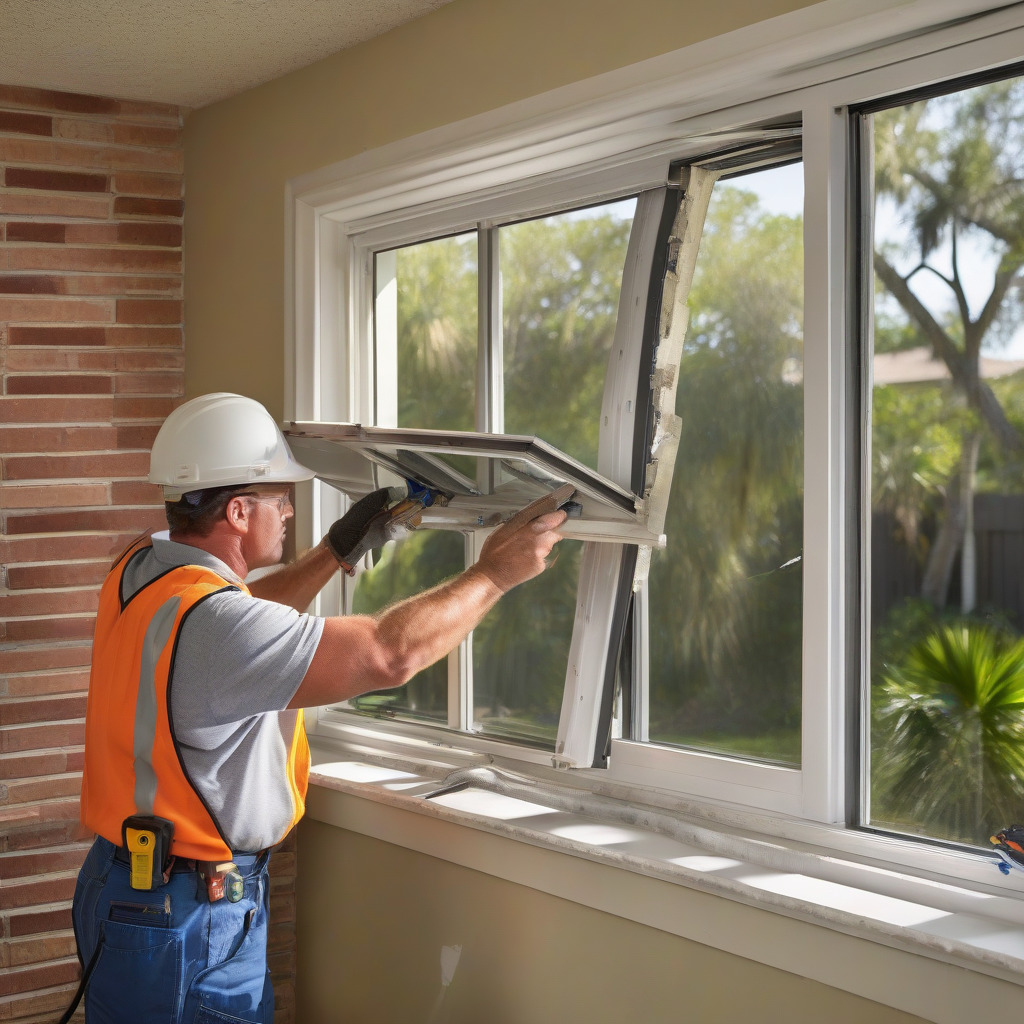
Budget tier. Volume installers serve the most common sizes found in 1970s and 1980s tract housing across Conway and Pine Hills. For a standard single-hung impact window in the 24-by-36-inch range, installed quotes in this tier ran between $400 and $700, including removal of the existing aluminum single-pane unit and hardware. Sliding glass doors are where homeowners get surprised: large openings start at $1,500 installed, which blows up the per-window average you may have been using to budget. These shops move volume and keep margins through speed rather than premium positioning.
Mid-market. Regional operators serving Orange and Seminole County land in the middle. Expect to pay roughly 25–40% above budget tier for standard single-hung units—the jump comes from frame material quality, better glass packages (low-E coatings, improved SHGC ratings), and warranty terms that extend beyond baseline coverage. The difference on a whole-house project is real money. It’s also potentially real insurance-credit money if the product approval documentation is cleaner and the inspector’s job is easier.
Premium tier. PGT WinGuard and CGI’s Series product line, installed by certified dealers, run roughly 20–30% above mid-range for comparable openings. Large picture windows and premium sliding glass door configurations are the line items that most frequently push whole-house projects toward the high end.
Second-story work adds cost across all tiers. Homes with poured-concrete window bucks—more common in pre-1980s construction in Colonialtown and Winter Park—may require additional structural work if an existing opening needs to be resized. One Winter Park contractor noted that homes built before 1965 sometimes need masonry repair around deteriorated window bucks that didn’t show up in the initial estimate. Ask specifically about this during your quote process. If a contractor seems annoyed by the question, that’s information.
A 1,600-square-foot, 1978 three-bedroom ranch with 12 standard windows and two sliding glass doors lands in an installed range of approximately $12,000 to $22,000, depending on product tier and site conditions. The variance on a job this size can easily be $3,000 to $4,000 between the lowest and highest legitimate bids. Get three quotes, in writing, itemized by opening. No exceptions.
Orange County’s Wind Zone Is Not Miami’s, and That Matters When You’re Reading Quotes
Orange County sits in a wind design zone governed by ASCE 7-22 at roughly 120 to 130 mph design wind speed. That’s meaningfully lower than the 170-plus mph requirements in coastal South Florida’s highest-exposure zones, where Miami-Dade Notice of Acceptance ratings represent the local minimum standard.
In Orange County, Florida Product Approval under Florida Building Code Chapter 16 is the baseline requirement, not Miami-Dade NOA. The Florida Department of Business and Professional Regulation’s product approval searchable database lists the design pressure rating for each approved product, and you can verify any product’s approval status there directly.
Here’s something worth knowing: some salespeople will specify Miami-Dade-rated product for an inland Orange County installation, pointing to the higher certification as evidence of quality. The product may well be excellent. But Miami-Dade NOA rating does not produce a larger insurance credit than a Florida Product Approval-rated window that meets your home’s actual design pressure requirements. You may be paying for a certification your home doesn’t require, with no insurance benefit to offset the added cost.
Ask any installer quoting you: “Is this product Florida Product Approval-listed for the design pressure required by my home’s opening sizes and location?” If they can’t answer directly, or if they default to “it’s Miami-Dade rated so it exceeds everything,” ask for the specific product approval number and look it up yourself in the state database. A contractor who fumbles that answer is either insufficiently trained or cutting corners on specifications. Either way, you want to know before you hand over a deposit.
The Orange County Permit Process—and Why Skipping It Destroys Your Insurance Claim
Window replacement in Orange County requires a building permit. Any installer offering to skip the permit to move faster or cut cost is offering you a path that will cost you far more than the permit fee when you file a wind mitigation report and discover the work can’t be certified.
Permits are pulled by the licensed contractor through the Orange County Building Division at 201 S. Rosalind Avenue in downtown Orlando. The current fee schedule is published at ocfl.net or available by calling the Building Division at (407) 836-5550—confirm the current figure before budgeting, as it can change. Your installer should be pulling this permit. If they ask you to pull it yourself as the homeowner, that’s a red flag about their licensing status. A licensed contractor carries responsibility for permitting. Shifting that to you suggests they may not carry the license they claim.
Under normal conditions, residential window replacement permit approvals run two to four weeks. Plan review queues stretch longer during peak season—verify the current timeline directly with the Building Division or your installer.
After installation, a county inspector must conduct a final inspection. That inspection is the precondition for everything that follows. No final inspection, no certificate of completion. No certificate of completion, and no wind mitigation inspector can legitimately certify your windows as compliant opening protection. The wind mitigation form is what your insurer uses to calculate your credit. Unpermitted work breaks that chain entirely. You’ve paid for a product and received no insurance benefit from it—and you’ve opened yourself to liability exposure if the installation fails during a storm.
If you live in Baldwin Park or any other community with an architectural review committee, you’ll need HOA approval before or concurrent with your permit application. Baldwin Park’s architectural standards specify allowable frame colors and, in some cases, glass specifications. The HOA approval process has delayed some projects by four to six weeks—a legitimate scheduling factor that some contractors conveniently forget to mention until after you’ve signed.
The full sequence: signed contract → permit application → permit approval (two to four weeks under normal conditions) → installation → county final inspection → wind mitigation inspection → form submission to your agent. Eight to fourteen weeks start to finish is realistic under normal conditions. If a contractor promises four weeks, ask specifically how they’re compressing the county’s permit review timeline, because there’s no legitimate shortcut there.
Which Insurers Actually Give You Money Back, and How Much
The figures below reflect what local agents report about carriers active in Orange County. Discount schedules change, individual premiums vary, and you should verify current figures with a licensed agent before making financial decisions based on insurer savings alone. That said, here’s what the market actually looks like—and for broader context on how carrier rate structures have shifted, Florida property insurance rate increases and what they mean for homeowners covers the regulatory backdrop driving these changes.
Citizens uses OIR Form OIR-B1-1802 to classify opening protection. The distinction that matters is between Classification “A” (all openings protected with rated product) and Classification “X” (no coverage). A Citizens policyholder who moves from X to A can see wind premium reductions of 15% to 45% depending on home age, construction type, and coverage tier. The actual dollar savings depends on your specific policy’s wind premium component—ask your agent to run a before-and-after comparison using a hypothetical Classification A rating. One important caveat: Citizens requires 100% of openings to be protected to achieve full Classification A credit. Partial protection produces a smaller discount, sometimes dramatically smaller. This means a phased approach to window replacement may produce no insurance savings until the final opening is protected. More on this in the next section.
Universal Property & Casualty absorbed a significant share of Citizens depopulation policies across Orange County. UPCIC offers wind mitigation credits on full-opening-protection scenarios, but agents report the credits can be less favorable when a home has mixed protection across openings. Don’t assume UPC’s discount schedule mirrors Citizens’—that assumption has cost homeowners real money.
Heritage Property & Casualty adjusts premiums based on OIR-B1-1802 findings, but its wind mitigation credit structure for older homes in inland counties should be verified directly with a licensed Heritage agent before you build it into your payback math. Heritage is also more likely to require an inspection before binding new policies on older construction, which extends your timeline if the work isn’t already complete.
HCI Group / Slide has emphasized newer construction in Orange County. Agents report that credits on pre-1980 construction may be thinner than what you’d see on a post-2002 home that already has some opening protection, and the company’s appetite for older inland homes has shifted several times in three years. Verify Slide’s current credit schedule directly before assuming it’s a favorable outlet for your project.
Private carriers in Florida aren’t required to match Citizens’ wind mitigation discount schedule. Each files its own rate schedule with the Office of Insurance Regulation. The credit for identical window product can vary meaningfully between carriers. Your wind mitigation report is portable—get quotes from multiple carriers after completing a window installation, because the insurer that rewards your investment most generously may not be your current one. An independent agent who represents multiple companies is better positioned for this comparison than a captive agent.
“The number of clients I’ve had who installed windows and never called me afterward to schedule the inspection—it happens every year,” says one Orlando-area licensed agent. “They spent $15,000 and they’re still paying the same rate.” Schedule the inspection the week the county final inspection clears. Don’t assume your agent will call you. The scheduling obligation is yours.
The Wind Mitigation Inspection—the Step That Determines Whether You Collect
The OIR Form OIR-B1-1802 is what your insurer uses to assign wind mitigation credits. It’s completed by a licensed home inspector or engineer with a wind mitigation certification—not your window installer, not the county building inspector, not your insurance agent. Verify that whoever you hire holds the current certification from the Florida Board of Professional Engineers.
In the Orlando market in mid-2026, a standalone wind mitigation inspection runs approximately $75 to $175 for a single-family home. The inspection takes 45 minutes to an hour. The inspector examines roof covering, roof deck attachment, roof-to-wall connections, roof shape, and opening protection. The last item is what impact windows directly affect. A thorough inspector will photograph the product approval label visible on the window unit itself, documenting it for the form.
The opening protection section is where your windows are evaluated. The inspector isn’t certifying the brand—they’re verifying that every opening (windows, doors, skylights) is protected with product that carries a valid Florida Product Approval or Miami-Dade NOA, and that installation was completed per the permit and product approval requirements. PGT WinGuard versus a budget-tier impact product doesn’t appear on the form. What appears is whether the protection is rated and complete.
Here’s what catches a lot of homeowners off guard: if you replaced the windows on the front and sides of your house but left jalousie windows in a rear Florida room or a single-pane window in the garage, you don’t have Classification A. You likely have a classification that produces little or no credit under most carrier schedules. If budget requires you to phase the project, understand clearly that phase one may produce zero insurance savings until the final opening is covered. Some homeowners discover this too late, having expected savings that never materialize because the project isn’t technically complete. It’s an avoidable situation, and the contractors who don’t tell you about it upfront aren’t doing you any favors.
The form is valid for five years. Set a calendar reminder for year four.
The Payback Math for a Typical Orlando Home—Honest Numbers
The benchmark: a 1,600-square-foot 1978 ranch in Conway, Citizens policy, $300,000 dwelling coverage. Local agents report that post-reform Citizens premiums for this profile in 2026—a 1970s ranch with no existing opening protection—are running $4,500 to $6,000 annually. Verify your own current premium as the baseline before you do any math. For a detailed look at what Orlando homeowners are paying across carrier types, our home & property coverage tracks current market conditions.
Installed cost at mid-market pricing for twelve standard windows and two sliding glass doors: roughly $12,000 to $22,000 depending on product tier and site conditions.
Citizens’ wind mitigation discount framework allows reductions of 15% to 45% for a full Classification A upgrade. On a $4,500–$6,000 baseline, annual savings could run from roughly $675 to $2,700 depending on the wind component of your specific policy. Because Citizens rate increases in 2024–2025 elevated the baseline premium, the raw dollar value of a percentage credit is higher now than it was several years ago. If you’re on the lower end—a home in a less wind-exposed part of Orange County—annual savings may be closer to $600. Higher-end policies could see savings above $2,500.
At mid-range installed cost and mid-range savings, payback lands somewhere in the seven-to-fourteen-year range for a Citizens-insured home with a significant wind premium component. That range widens considerably for private carrier policyholders whose carriers offer thinner wind mitigation credits. Before signing a contract, ask your agent to run actual dollar savings under your current policy—not a percentage abstraction. A $15,000 installation with $1,200 annual savings is a genuinely different financial story than the same installation with $600 annual savings.
Energy savings from better glass packages are real but modest. You might save $10–$20 per month on cooling costs with premium low-E glass, depending on the home’s exposure. Don’t let a salesperson lead with energy savings as the primary pitch.
Resale value enters the calculation differently by neighborhood. Impact windows are a recognized feature in the Orange County market, particularly in Winter Park and College Park, where buyers are acutely aware of hurricane exposure. Resale premiums in the 2–5% range are commonly cited in the literature; apply any such estimate conservatively and verify against recent comparable sales in your specific neighborhood. In Conway, the buyer pool is more price-sensitive, and the resale premium for impact windows is probably thinner.
For homeowners on private carriers with thinner credits, the payback on a $12,000-plus installation can stretch well beyond fifteen years without secondary benefits. At that point, the financial case rests almost entirely on storm protection and resale positioning. That’s a legitimate case—storm exposure is real, and the insurance market keeps moving in directions that may compress that payback over future renewal cycles—but it deserves clear-eyed evaluation, not just a contractor’s enthusiasm. If you’re in Conway or Pine Hills with tight equity margins, run both the optimistic and the pessimistic version of this math before you sign anything.
How This Decision Plays Out Across Orange County Neighborhoods
Winter Park and College Park have older housing stock from the 1960s to 1980s, typically single-pane aluminum throughout, frequently on Citizens or recently pushed to private carriers. The combination of high original premium, meaningful wind exposure, and a strong resale market makes this one of the better ROI profiles in Orange County. These neighborhoods also have active word-of-mouth networks—if three houses on your block used the same crew and had good results, that’s worth more than a Yelp review.
Horizon West and Lake Nona saw most post-2002 construction built with impact glass already specified, either as a builder standard or common upgrade. If you’re in a 2010-or-later home in Horizon West, check your original builder paperwork or have a wind mitigation inspector verify your current status before budgeting for new windows. You may already have Classification A, which changes the question entirely. For buyers who picked up pre-2002 inventory in these corridors, the calculus looks more like the Winter Park profile.
Conway, Pine Hills, and Azalea Park contain dense 1960s-to-1980s ranch stock, often with lower property values that compress the resale premium argument. This is where the payback math gets genuinely harder. The homeowners who most need impact windows from a wind exposure standpoint sometimes have the tightest margin for a $12,000-plus cash outlay. Several regional financing companies offer contractor-integrated plans that spread the cost across 60 to 84 months—roughly $180–$200 per month depending on rate and term. The cost of money is real, but for households managing tight monthly budgets, the monthly cash flow comparison against the insurance savings is worth running carefully. Don’t let a contractor tell you the financing “basically pays for itself.” Sometimes it does. Often it doesn’t. Do the actual math.
Baldwin Park has an HOA review layer that adds three to four weeks to your timeline. Verify approved frame colors before you get installer quotes—frame color restrictions can eliminate mid-market product options that work fine everywhere else in Orange County. Most of the housing stock here is post-2000, so some units already have impact glass. Check your original builder specs before assuming you’re starting from zero.
What to Ask Before You Sign an Installation Contract
These questions come directly from the specifics above, not from generic consumer advice columns.
Is the specific product Florida Product Approval-listed for my home’s design pressure requirements? Get the Florida Product Approval number in writing and verify it in the state database. “It’s Miami-Dade approved” is not a substitute answer.
Will you pull the Orange County building permit, and can I see your current state contractor license number and insurance certificate? If they ask you to pull the permit as the homeowner, that’s a disqualifying answer. Verify the license number at the DBPR’s contractor license search—it takes three minutes and is worth doing.
What does the contract say about permit delays? A backlog at the Building Division shouldn’t trigger penalty clauses against you. The contract should acknowledge that permit review delays shift the installation date without penalty.
Is this an all-in price? Confirm the quote covers removal of existing windows, disposal, installation, all hardware, and stucco or drywall repair around the buck. Ask specifically whether second-story openings are priced the same, and whether unusual configurations trigger additional fees. Get it itemized. Vague quotes produce surprise invoices.
What’s the actual lead time from deposit to installation date, in writing? Eight to twelve weeks is common in mid-2026. If a contractor says four weeks, ask specifically how they’re guaranteeing that despite permit review timelines. If they can’t explain it, the promise is empty.
How does the warranty work if a window fails the county inspection? The installer remediates at no cost to you—full stop. If the contract is vague on this, ask for clarification before signing.
What documentation will you provide for my wind mitigation inspector? You need the product approval documentation, permit number, and certificate of completion. A professional installer hands you a packet with photographs of product approval labels and the completed installation. Some installers even provide pre-filled portions of the OIR form to speed the process—that kind of detail signals a shop that’s done this enough times to know what comes next.
The decision in front of most Orange County homeowners isn’t a comfortable one. A $12,000-to-$22,000 outlay with a payback period that depends heavily on your carrier and wind premium component is a hard sell when interest rates are still elevated and insurance costs have already stretched household budgets. What makes it defensible is the combination of storm exposure reduction, resale positioning, and the real possibility that your carrier’s pricing makes the savings calculation improve over the next several renewal cycles. Citizens’ wind premium component has been rising as a share of the total bill—a $15,000 installation that saved $600 in year one might save $1,200 in year five.
What makes it worse than the math suggests is the homeowner who installs the windows, pays the contractor, and never schedules the wind mitigation inspection. That person spent $15,000 and received $0 in annual credit. The inspection is the step that unlocks the benefit. Don’t let it slide. Schedule the inspection the week the county final inspection clears, submit the form to your agent the same week you receive it, and follow up to confirm the new rate has actually been applied. The discount doesn’t happen automatically. You have to collect it.
CityDesk Orlando contacted Central Florida installers for pricing information in mid-2026; all figures require verification with written quotes from licensed contractors for your specific project. Insurance credit figures reflect the general framework described by local agents and Citizens’ published discount structure; individual premiums vary based on policy specifics, coverage levels, carrier, and property characteristics. Permit fees and timelines are based on Orange County Building Division published information as of mid-2026 and are subject to change; verify current figures at ocfl.net or by calling (407) 836-5550.