My Florida LLC Got Administratively Dissolved and Here Is What to Do Right Now
The May 1 annual report deadline has passed, and SunBiz is now showing thousands of Orlando-area LLCs as inactive. If yours is one of them, your liability protection is already gone. Here's how to …


My Florida LLC Got Administratively Dissolved and Here Is What to Do Right Now
The May 1 annual report deadline has passed, and SunBiz is now showing thousands of Orlando-area LLCs as inactive. If yours is one of them, your liability protection is already gone. Here’s how to fix it before it costs you more.
You went to open a business bank account, renew a lease, or pull a permit, and something stopped you cold. Maybe the bank’s compliance software flagged your entity. Maybe the landlord’s attorney ran a quick SunBiz search. Maybe you checked yourself, on a hunch, and saw the word you were dreading: Inactive.
That single word on the Florida Division of Corporations website is not a paperwork hiccup. It’s the public record of a legal event that already happened, and the consequences started the day it did—not the day you found out.
Florida’s annual report deadline for LLCs was May 1. Business owners who missed it received a late notice and an extended window, but for those who still didn’t file, administrative dissolution became effective by state law. June is when the calls start coming in to attorneys, CPAs, and the Orlando SBDC. June is when bank representatives explain they can’t open the account. June is when a general contractor on an Orange County job site is told they can’t be added to a permit pull. If you’re reading this in that exact moment—staring at your phone in a parking lot, or sitting across from a banker who just told you there’s a problem—this article is written for you. Here is precisely what you’re dealing with, what it costs you, and what to do today.
What “Administratively Dissolved” Actually Means Under Florida Law
Florida Statutes §§605.0702 and 605.0703 lay out a process that is automatic and mechanical. When an LLC fails to file its annual report by May 1, the Division of Corporations sends notice. If the report still isn’t filed, the Division administratively dissolves the LLC. No court order. No hearing. No further warning. The entity’s status on SunBiz.org changes to “Inactive.”
The date that change took effect is recorded in your entity’s public file. Look at it carefully, because everything that happened after that date is affected.
Administrative dissolution is not a fine. It’s a legal transformation of what your LLC is allowed to do. Most Orlando business owners don’t discover it in May—they discover it in June, when they run into a process that requires verification of their business entity’s standing. The bank, the title company, the county permitting office, or the counterparty’s lawyer checks SunBiz. What they find is that your LLC no longer exists as an active entity. That’s when owners discover a problem they didn’t know they had, sometimes months after the fact.
You Cannot Legally Operate Right Now
This is the question every dissolved LLC owner asks first. The answer is direct: no, you can’t legally operate your business as normal.
Florida Statutes §605.0704 describes what a dissolved LLC may and may not do. The law permits the LLC to wind up its existing affairs—collecting money already owed, paying existing debts, closing out contracts that were in progress before dissolution. That narrow permission is not a loophole to keep operating. It is a legal framework for orderly shutdown.
What §605.0704 does not permit: conducting new business, signing new contracts, onboarding new clients, or doing anything that would be normal business activity if the LLC were active. The moment your LLC was dissolved, the legal entity that your business operated through stopped existing in the eyes of Florida law.
Here’s the part that actually keeps people up at night. The liability protection is gone. The entire point of the LLC structure—the wall between your personal assets and your business obligations—depends on the LLC existing as a valid legal entity. Once that entity dissolves, members and managers who continue operating under the LLC name are exposed personally. If a customer sues, if a vendor files a claim, if a contractor gets hurt, the shield isn’t there. Courts have held members personally liable for obligations incurred on behalf of a dissolved entity precisely because the entity doing the incurring had no legal standing to act.
If you’ve continued operating since the dissolution date—taking on new clients, signing vendor agreements, cashing checks for new work—stop and read Section 8 of this article before you do anything else.
What Happens to Contracts and Leases You Signed After Dissolution
Under Florida law, contracts executed by a dissolved LLC are not automatically void. They are voidable. The distinction matters enormously. A void contract never existed. A voidable contract exists but can be challenged by a party who was harmed or misled. If the other party to your agreement didn’t know your LLC was dissolved when you signed, they may have grounds to void the agreement, seek damages, or hold the individual who signed it personally responsible.
Consider what this looks like in practice. A promoter whose LLC was dissolved signs a vendor agreement for an International Drive tourism event in June. The contract is voidable, and the venue or vendor could walk away or pursue the individual who signed. A Mills 50 retail tenant whose LLC dissolved in May renews a three-year lease in June without reinstating first. The landlord’s attorney, if they discover the dissolution, may argue the lease is unenforceable or use it as leverage in a later dispute — and as our coverage of Orlando landlord-tenant rights shows, landlords generally have more tools than tenants expect when entity standing is in question. A subcontractor on an Orange County construction project submits a bid under the dissolved LLC name and gets awarded a contract. The general contractor, if they find out, can void the arrangement, and the subcontractor’s principals may face personal exposure on any work already performed. A service vendor pulls a permit under the dissolved entity’s name and later gets sued when a client alleges injury. The LLC’s dissolved status becomes leverage to argue the vendor acted without authority and is personally liable.
These situations come up in Florida contract disputes more often than most people realize, and they tend to cluster in the month or two after the May 1 deadline, when dissolved LLCs are still in the field operating as though nothing happened. The timing of when the other party finds out matters just as much as when you find out. If you signed after dissolution and they find out later, they have a legal option you don’t: to void the agreement entirely.
If you’re currently party to an active agreement—a lease, a vendor contract, a subcontract, a service agreement—that you signed after your dissolution date, reinstatement alone doesn’t cure the problem retroactively. Florida law allows reinstatement to relate back to the date of dissolution for some purposes, but whether it cures a specific voidable contract is a legal question that depends on the facts of the agreement and the parties involved. This is where you need an attorney, not a how-to article.
The Exact Steps to Reinstate Your LLC on SunBiz Today
If you’ve confirmed that no active contracts or disputes are tied to the period since your dissolution, reinstatement through SunBiz.org takes about 20 minutes. Genuinely — it’s one of the more functional government portals I’ve encountered.
Step 1: Navigate to your entity record on SunBiz.org. Go to dos.myflorida.com/sunbiz and select “Search Records” from the top navigation, then choose “Search by Entity Name” or “Search by Document Number.” Search your LLC name. When your record appears, confirm the status field reads “Inactive – Administrative Dissolution.” Note the exact dissolution date. You’ll need it to calculate fees.
Step 2: Click “Reinstate” in your entity record. From your entity’s detail page, a “Reinstate” button will appear if the LLC is eligible for reinstatement. Click it. The system will prompt you to file the delinquent annual reports for each year missed, beginning with the first unpaid report year. You must file all delinquent reports in sequence before reinstatement processes.
Step 3: Update your registered agent and office address. This is the single most common reason Orlando LLCs get dissolved in the first place — and it’s almost always because the address quietly became invalid somewhere along the way. Florida law requires every LLC to maintain a registered agent with a physical Florida street address. A post office box is not sufficient. If your registered agent was a downtown Orlando attorney or CPA firm that has since moved, merged, or closed, that address is likely invalid, which may have caused the original dissolution in the first place. You can’t reinstate until the registered agent information reflects a current, valid Florida street address. If you’re Orange County-based and need to designate yourself as your own registered agent, you may use your principal business address, but it must be a street address in Florida, and you must be available there during business hours.
Step 4: Complete payment. The SunBiz reinstatement portal accepts credit cards only. No checks, no wire transfers. Have your card ready before you start the process, because incomplete sessions can create complications. See the next section for the exact fee amounts.
Step 5: Confirm processing timeline. If you file before 5:00 p.m. Eastern, the Division of Corporations processes reinstatement filings on the same business day. Your LLC’s status will typically reflect as “Active” on SunBiz within 24 to 48 hours. Until that Active status appears publicly, treat your entity as still dissolved for purposes of any third-party verification. Don’t sign contracts or open accounts until you can show the Active record.
Exactly What Reinstatement Will Cost You
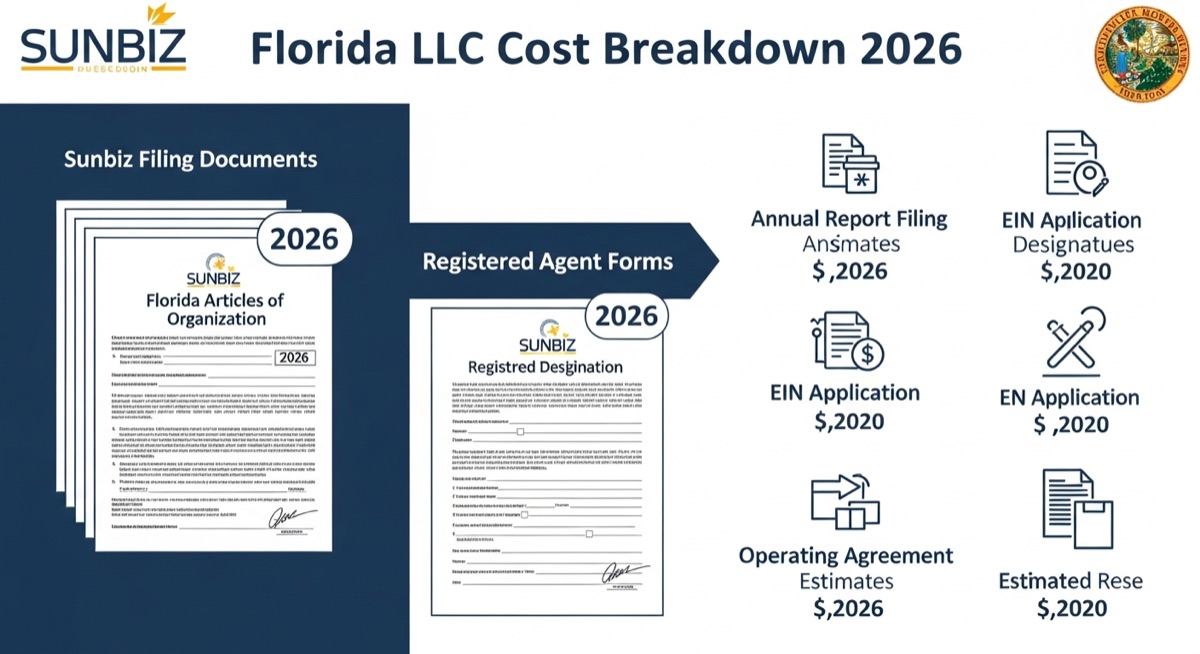
Florida’s reinstatement fee schedule is mechanical and predictable:
- Annual report filed on time (before May 1): $138.75
- Annual report filed after May 1 (late fee applied): $538.75
- Reinstatement fee: $100.00 flat
Reinstatement after one missed annual report cycle costs $638.75 total ($538.75 late annual report + $100 reinstatement fee).
If your LLC has been inactive longer, the math compounds steeply:
| Years Dissolved | Annual Report Fees | Reinstatement Fee | Total |
|---|---|---|---|
| 1 year | $538.75 | $100.00 | $638.75 |
| 2 years | $538.75 × 2 = $1,077.50 | $100.00 | $1,177.50 |
| 3 years | $538.75 × 3 = $1,616.25 | $100.00 | $1,716.25 |
Waiting does not save money. It adds another full late-fee cycle on top of everything already owed. Each additional missed annual report year adds another $538.75 to your total. Act now if you’re going to act.
Does Dissolution Ever Become Permanent
Many law firm websites claim that Florida LLCs must be reinstated within five years or they’re permanently dissolved. That claim misapplies the corporate rule under Chapter 607, which governs Florida profit corporations, not LLCs. Under the Florida Revised LLC Act, Chapter 605, there is no hard statutory deadline after which reinstatement becomes categorically unavailable.
That doesn’t mean dissolution can wait indefinitely. The most common practical barrier is this: another entity claiming your LLC’s name. Florida names are available on a first-registered basis. If your dissolved LLC sat inactive long enough that someone else registered a new entity using the same or a confusingly similar name, you may not be able to reinstate under your existing name. Before you file anything on SunBiz, run a name search to confirm no active entity has claimed your LLC’s name since your dissolution date. If your name has been taken, you’d need either to negotiate with the other entity or to reinstate under a modified name, and either option warrants an attorney’s involvement.
The practical reality: there’s no hard clock running on reinstatement eligibility under current Florida LLC law, but the cost goes up, the name risk goes up, and the complication from ongoing operations goes up the longer you wait. There is no version of this where waiting helps you.
Your Orange County Business Tax Receipt Is a Separate Problem
Almost every guide to Florida LLC reinstatement stops at SunBiz. This one doesn’t.
Orange County and the City of Orlando both require a Business Tax Receipt (BTR) to operate legally within their jurisdictions. BTRs renew annually, and the deadline is September 30. The Orange County Tax Collector’s office at 200 S. Orange Ave. handles county-level BTRs. For businesses operating inside city limits, Orlando Permitting Services at 400 S. Orange Ave. handles the city BTR.
A dissolved LLC owner attempting to renew a BTR is renewing a receipt tied to an entity that no longer legally exists in good standing. If a compliance question arises—an inspection, a dispute with a landlord, a licensing issue with a contractor’s board—the LLC’s legal status governs, and a current BTR does not substitute for a valid, active entity. The permitting office may not catch a discrepancy between BTR renewal and LLC status immediately, but the gap creates exposure down the line. If you renew your BTR in September while your LLC is still dissolved, and a landlord or regulatory body later reviews your filings, the mismatch is sitting right there on the public record.
Don’t put yourself in the position of trying to handle both a dissolved LLC and a BTR complication at the same time. Complete SunBiz reinstatement before your September 30 BTR renewal. If you have questions about your specific BTR situation while your LLC is dissolved, call Orange County Tax Collector at (407) 434-0312 or Orlando Business Tax Division at (407) 246-2204 before submitting renewal paperwork.
When to Stop and Call an Attorney Instead
This article covers what an Orlando business owner can handle independently in about 20 minutes on SunBiz. It doesn’t cover everything, and I want to be honest about that line.
Filing reinstatement yourself before getting legal advice can make a bad situation worse. You should call an attorney before reinstating if any of the following are true:
- You signed contracts, leases, or agreements after your dissolution date that are still active
- You have a dispute, demand letter, or pending litigation involving your business
- Your LLC has been inactive for more than one annual report cycle and you continued operating
- Your LLC name has been claimed by another entity on SunBiz
- You have multiple members and there is any question about authority to act on behalf of the entity
The fastest local entry point is the Orange County Bar Association Lawyer Referral Service at (407) 422-4537. For an initial conversation, they can connect you with a business attorney who can assess your situation before you take any action on the record.
Two no-cost local resources exist if you need guidance before you’re ready to retain an attorney. The Florida SBDC at UCF, located at 12565 Research Pkwy. in Orlando, offers free one-on-one consulting with advisors who understand Florida entity compliance. This kind of compliance gap is also exactly the type of situation covered in our legal & finance coverage of Orlando-area small business issues. Central Florida SCORE also provides free mentoring for small business owners facing exactly this kind of regulatory situation. Neither can give you legal advice, but both can help you understand your situation and figure out whether you need an attorney before you act — which is worth a phone call before you do anything else.
Your Immediate Action Checklist
-
Search your LLC on SunBiz right now and confirm its exact status and dissolution date. Go to dos.myflorida.com/sunbiz, search your entity name, and record the exact status shown and the date dissolution took effect. Screenshot the record.
-
Check whether your LLC name has been claimed by another entity. Run a name search on SunBiz for your exact LLC name and any close variations. If an active entity is using your name, stop and call an attorney before proceeding.
-
Identify your current registered agent and confirm the address is valid. Open your entity record and look at the registered agent field. Confirm the address listed is a current, valid Florida street address — not a P.O. box or the address of a firm that has moved or closed. If it needs updating, have the corrected address ready before you start the reinstatement filing.
-
Calculate your total fees. Use the fee table above. Multiply the number of delinquent annual report years by $538.75, then add the $100 reinstatement fee. Have a credit card ready for that amount.
-
File reinstatement on SunBiz today, if no active contracts or disputes are tied to the dissolution period. Complete the reinstatement process before 5:00 p.m. Eastern for same-day processing. Confirm Active status within 48 hours and document it.
-
Call an attorney before reinstating if you have signed agreements, open disputes, or a lapse longer than one annual report cycle. Reinstatement does not automatically fix actions taken while dissolved. If your situation is complicated, get legal advice before you create a public record that may affect ongoing matters.
The difference between handling this in June and handling it in October is measured in hundreds of dollars in additional fees, a BTR renewal caught up in a compliance gap, and months of operating without liability protection while the window to fix it cheaply stays open. SunBiz is straightforward when your situation is clean. The phone numbers and addresses in this article are there for when it isn’t.
Fix this today.