What to Know About Florida Security Deposit Law
Florida's security deposit statute sets hard deadlines and a certified-mail requirement that most renters never know about — until they've already lost the money.

What to Know About Florida Security Deposit Law
Florida’s security deposit statute sets hard deadlines and a certified-mail requirement that most renters never know about — until they’ve already lost the money.
If you rent in Orlando, your security deposit is probably the largest single chunk of money you’ve handed over in the course of finding a place to live. One-bedroom apartments in Orlando commonly require deposits in the $1,500-to-$3,600 range, with higher-end units and newer construction running further north. When you move out, that money either comes back or it doesn’t — and for a lot of renters, the outcome feels like a coin flip conducted entirely on the landlord’s terms.
It isn’t. Florida law sets specific, enforceable deadlines on what a landlord must do after you vacate, and the penalty for missing those deadlines isn’t a slap on the wrist. It’s forfeiture of the entire claim. The problem is that most tenants have no idea the mechanism exists — and many landlords are counting on that.
This piece explains how Florida Statute §83.49 actually works, what happens when a landlord violates it, and what Orange County renters can do about it.
The Two Deadlines Florida Law Actually Creates — and Why They’re Different Numbers
Most articles on this subject say “landlords have 30 days to return your deposit.” That’s not wrong exactly, but it’s incomplete enough to be misleading. Florida Statute §83.49 creates two distinct timelines, and they operate differently depending on what the landlord intends to do.
If the landlord intends to return the deposit in full, they have 15 days from the date you vacate to return the entire deposit.
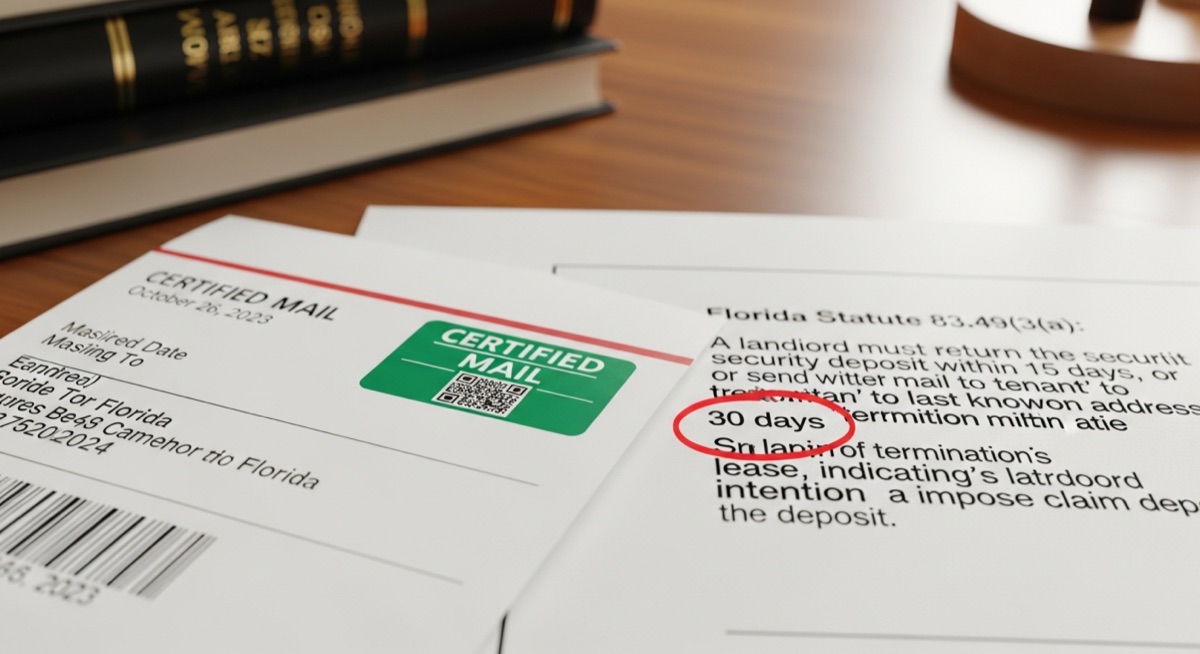
If the landlord intends to make any deduction at all, they have 30 days from the date you vacate to send you a written notice of their claim. That notice must go out by certified mail.
Here’s how that plays out in sequence: You vacate the unit and return the keys on Day 0. If the landlord has no claim against your deposit, the full amount is due back to you by Day 15. No letter required, no notice — just the money. If the landlord plans to keep any portion of the deposit, they must have sent you a written notice of that intent by Day 30, sent by certified mail to your last known address. After you receive the landlord’s written claim notice, you have 15 days to send a written objection. If you don’t object within that window, the landlord may then deduct the claimed amounts and return the remainder.
The distinction matters enormously in practice. A landlord who returns nothing and sends nothing by Day 30 hasn’t just been slow — they’ve forfeited their legal right to keep any of the money.
What the Required Written Notice Must Actually Say — and Why Certified Mail Is Not Optional
When a landlord intends to impose any claim against a security deposit, §83.49(3)(a) specifies what that notice must include and how it must be delivered. The statute requires three things: the notice must be sent by certified mail to the tenant’s last known mailing address, it must state the landlord’s intent to impose a claim on the deposit, and it must identify the specific deductions the landlord intends to make.
All three elements matter equally. A landlord who sends a detailed itemized list by text message hasn’t complied with the statute. A landlord who mails a certified letter saying only “I’m keeping your deposit” without specifying the deductions hasn’t fully complied either. And a landlord who mails the notice by regular first-class mail — no certified tracking — hasn’t satisfied the requirement, regardless of whether the tenant actually received it. The certified-mail requirement exists to create a verifiable record, and substituting a more convenient method doesn’t satisfy it. A screenshot of a text thread, however detailed, is not going to cut it in small claims court.
Once the tenant receives the certified notice, the clock shifts. The tenant has 15 days to respond in writing with any objection. If the tenant doesn’t respond within those 15 days, the landlord can then deduct the claimed amounts from the deposit and return the balance, if any. The tenant’s failure to respond doesn’t mean they agree with the deductions — it simply removes one layer of procedural protection. The tenant can still dispute the underlying charges in small claims court; they’ve just lost the window to object under the statute’s pre-litigation procedure.
The Forfeiture Consequence: What Happens When a Landlord Misses the Deadline
Under §83.49(3)(a), a landlord who fails to send the required certified-mail notice within 30 days of the tenant vacating forfeits their right to impose any claim against the deposit. Not a reduced claim. Not a claim limited to provable damages. The entire claim. The landlord must return the full deposit amount. That’s a serious legal consequence for what can be as simple an error as sending the notice by regular mail, waiting 32 days instead of 30, or sending a compliant letter to an old address rather than the tenant’s forwarding address.
The attorney’s fees provision adds real teeth to the law. Under §83.49(3)(c), if a landlord wrongfully withholds a deposit and the tenant prevails in court, the court may award the tenant their reasonable attorney’s fees and court costs. That changes the landlord’s calculus dramatically — even if they believe their underlying damage claims are legitimate. In pre-litigation conversations, a landlord who knows they missed the deadline and knows they may owe attorney’s fees has a strong financial reason to settle without going to court.
It’s worth being precise about what “forfeiture” means here, though, because there’s a misconception worth clearing up. The landlord doesn’t lose the deposit automatically by operation of law at Day 31. What they lose is the legal right to assert a claim. They still have the money, at least until a court orders otherwise. This means tenants who are owed a return under these circumstances do need to act — either by demanding the return in writing or, if that fails, by filing in small claims court. A written demand, sent by email or certified mail with a date stamp, creates a record of the tenant requesting the money back. If the landlord doesn’t respond within a few days, that record becomes useful evidence of bad faith at the small claims hearing.
What Landlords Can and Cannot Legally Deduct
Even when a landlord follows the procedural requirements perfectly, they can only deduct for certain things. Florida case law draws a line at normal wear and tear, which is not deductible, versus actual damage caused by the tenant, which is. The statute itself doesn’t define “normal wear and tear” — that line comes from how Florida courts have applied the concept over time, which means there’s more gray area here than either side usually admits.
Paint that’s faded, scuffed, or dulled from ordinary use over a tenancy of a year or more is normal wear and tear. Carpet that’s worn thin or lost its texture through normal foot traffic is normal wear and tear. Minor scuffs consistent with regular use are normal wear and tear.
Legitimate deductions cover actual damage: holes punched or kicked in walls, carpet stained with pet urine or bleach or paint that requires replacement, broken doors, windows, or fixtures. The practical problem is that these categories blur at the edges — a landlord replacing carpet in a unit where a tenant lived for four years is on very different footing than one replacing carpet in a unit where someone lived for eight months. Age, quality, and expected lifespan of the original materials all factor into whether a deduction is legitimate. If you lived in the unit for ten years and the carpet was original to the building, the landlord’s case for a carpet replacement deduction is weak. If you lived there for six months and somehow managed to put a bleach stain across half the living room, the landlord’s case is strong.
There’s also a separate requirement that landlords frequently overlook at the beginning of the tenancy: under §83.49(2), landlords who collect a security deposit must notify the tenant in writing within 30 days of receiving the deposit of the name and address of the Florida financial institution where the deposit is held, whether the account is interest-bearing or not, and the rate of interest if applicable. Landlords can alternatively post a surety bond. The deposit must be kept in a separate, non-commingled Florida bank account — it cannot be mixed with the landlord’s operating funds or personal finances. If a landlord fails to provide this notice at the start of the tenancy, that’s a separate violation with its own consequences, though the remedy for that one differs from the move-out scenario.
What Tenants Must Do to Protect Their Own Rights
Florida’s deposit law has teeth for tenants, but it also has obligations. Several of the statute’s protections depend on the tenant having done specific things — and most coverage of this law omits this half of the picture entirely. For a broader look at the rights Orlando renters hold throughout their tenancy — not just at move-out — our landlord-tenant rights coverage walks through the full framework under Florida law.
Provide a written forwarding address at move-out. This is critical. The 30-day clock runs to the tenant’s “last known address,” and if a landlord can credibly argue they had no forwarding address and mailed the notice to the leased premises (where the tenant no longer lives), that becomes a usable defense against a forfeiture argument. Before you hand in your keys, give the landlord a written forwarding address in a format that creates a record: a signed move-out form, an email, a text message. Keep a copy. Seriously — this one step closes a loophole that landlords have successfully used to dodge the forfeiture consequence.
Document the unit’s condition at move-out with dated photographs. Walk every room. Open every cabinet. Photograph every wall, every floor, every appliance, every fixture — before you leave and before you hand over the keys. The timestamp on your phone’s camera is a form of documentation. If the landlord later claims the carpet was destroyed, you want dated photographic evidence of what it looked like when you left. Take video too if you can. A 30-second walk-through video of the unit at move-out, timestamped, is nearly impossible to dispute and takes almost no time to record.
Obtain written move-out confirmation where possible. Some landlords will do a move-out walkthrough with you present and sign a condition report. If yours will, get it in writing. If they won’t, that’s their prerogative — but your photographs and your documented return of keys (keep the receipt or get a text confirmation) serve a similar function. The goal is to establish what condition the unit was in when you left, because if the landlord later sends you a claim notice for damage, you’ll need evidence to contradict it.
If you receive the landlord’s 30-day certified notice and you believe the deductions are improper, send any written objection within 15 days of receiving the notice, and do it in a way that creates a record. Certified mail is ideal; email with a delivery receipt works; even a text message is better than nothing if you need to prove you objected. If it comes down to a small claims hearing, you’ll need to show you objected and when.
How to File a Small Claims Case in Orange County If Your Deposit Isn’t Returned
If your landlord has failed to return your deposit, failed to send proper notice, or sent notice of deductions you believe are unlawful, Orange County Small Claims Court is the practical venue for most tenants. No attorney is required, the filing fees are modest, and the process is designed to be accessible to people representing themselves.
You can claim the full withheld deposit, plus attorney’s fees and court costs if the court finds the withholding was wrongful. Florida’s small claims court handles civil claims up to $8,000 under §34.01, and most security deposit disputes fall well within that range. You’ll file at the Orange County Courthouse Civil Division, located at 425 N. Orange Avenue in downtown Orlando. Before you go, confirm the current filing location, hours, and fee schedule at myorangeclerk.com, since courthouse procedures, counter locations, and fees are subject to change.
Filing fees scale with the amount claimed and are set by statute. Confirm the current fee schedule with the clerk’s office or at myorangeclerk.com before filing. Once you file a Statement of Claim at the civil clerk’s window, the clerk’s office serves the defendant — your landlord or property management company — with a copy of your claim and a notice of the hearing date. You’re not responsible for personally serving the defendant in small claims court. The typical timeline from filing to hearing in Orange County runs 30 to 70 days, depending on the court’s docket.
Bring your lease, your move-out documentation (photographs, forwarding address records, key return confirmation), copies of any certified mail receipts or tracking information, any communications with the landlord about the deposit, and a clear written summary of your claim to the hearing. The judge will hear both sides; there’s no jury in small claims. Winning a judgment isn’t the same as collecting the money, but a court judgment in your favor creates enforceable collection rights, including the ability to garnish a bank account or place a lien on property. Most landlords pay rather than deal with collection proceedings.
Free and Low-Cost Legal Help Available to Orlando Renters
Two organizations provide free civil legal assistance to low-income Orange County residents and handle landlord-tenant matters, including security deposit disputes.
Legal Aid Society of the Orange County Bar Association is the primary local resource. Their office is located on Robinson Street, near the courthouse. They serve residents who meet income eligibility requirements — generally at or below approximately 200 percent of the federal poverty level. Intake is conducted by phone; call ahead to confirm current hours and whether walk-in intake is available, as that has varied with staffing. A legal aid attorney can review your situation, advise you on whether you have a viable claim, and in some cases represent you at a small claims hearing.
Community Legal Services of Mid-Florida is a second option covering Orange County. They handle a range of civil legal issues including landlord-tenant disputes and can provide advice and limited representation to qualifying clients. Both organizations prioritize cases with clear statutory violations — a landlord who missed the 30-day deadline without sending proper notice is exactly the kind of case a legal aid attorney can work with efficiently. If that’s your situation and you qualify on income, it’s worth a call before you try to navigate small claims on your own. Those same organizations also appear in our free and sliding-scale healthcare in Orlando coverage — a useful reference if cost of legal and medical services is a broader concern.
A Note for Landlords: Compliance Is Cheaper Than Litigation
This article is written for tenants, but landlords read it too — and the message here is straightforward: the cost of getting this wrong is substantially higher than the cost of a postage stamp and a calendar reminder.
Compliant practice under §83.49 starts when you receive the deposit. Within 30 days, notify the tenant in writing of the Florida financial institution where the deposit is held in a separate, non-commingled account — or post a surety bond. When the tenant vacates and you intend to return the deposit in full, return it within 15 days. When the tenant vacates and you intend to make any deduction, send a written notice of your specific claims by certified mail to the tenant’s forwarding address within 30 days of vacancy. Keep the certified mail receipt and tracking record.
That’s the entire compliance framework for most standard situations. The landlord who misses the 30-day deadline, sends notice by email rather than certified mail, or fails to specify the deductions doesn’t just lose the procedural argument — they lose the substantive right to withhold anything, and they expose themselves to paying the tenant’s attorney’s fees if the case goes to court. Procedural compliance would have avoided that outcome entirely.
Property managers handling multiple units in the Orlando rental market should have a documented move-out checklist and a certified-mail workflow that fires automatically within the first week after vacancy. The 30-day deadline sounds generous until you account for the time needed to document damage, get repair estimates, and draft a compliant notice. A simple calendar system or property management software reminder reduces the error rate to near zero. This really isn’t complicated — it’s a process problem, not a legal one.
What You Need to Know
Florida law doesn’t leave security deposit disputes entirely to the landlord’s discretion. It sets hard deadlines, specifies the form of required notice, and imposes a serious penalty — complete forfeiture of the right to withhold — when a landlord fails to comply. The mechanism exists. Most renters in Orlando don’t know to invoke it.
If your landlord has kept your deposit without sending you a certified-mail notice within 30 days of your move-out, you have a legal basis to demand the full return. If they don’t comply, Orange County Small Claims Court is accessible, and no attorney is required. If you need help navigating the process and your income qualifies, Legal Aid Society of the Orange County Bar Association is the place to start.
The 30-day clock started running the day you handed back your keys.