How to Identify and Avoid Notario Fraud in Orlando
A ground-level guide to a documented consumer harm on the OBT and Semoran corridors — with named local resources, verification tools, and a remediation path if you've already been targeted.
How to Identify and Avoid Notario Fraud in Orlando
A ground-level guide to a documented consumer harm on the OBT and Semoran corridors — with named local resources, verification tools, and a remediation path if you’ve already been targeted.
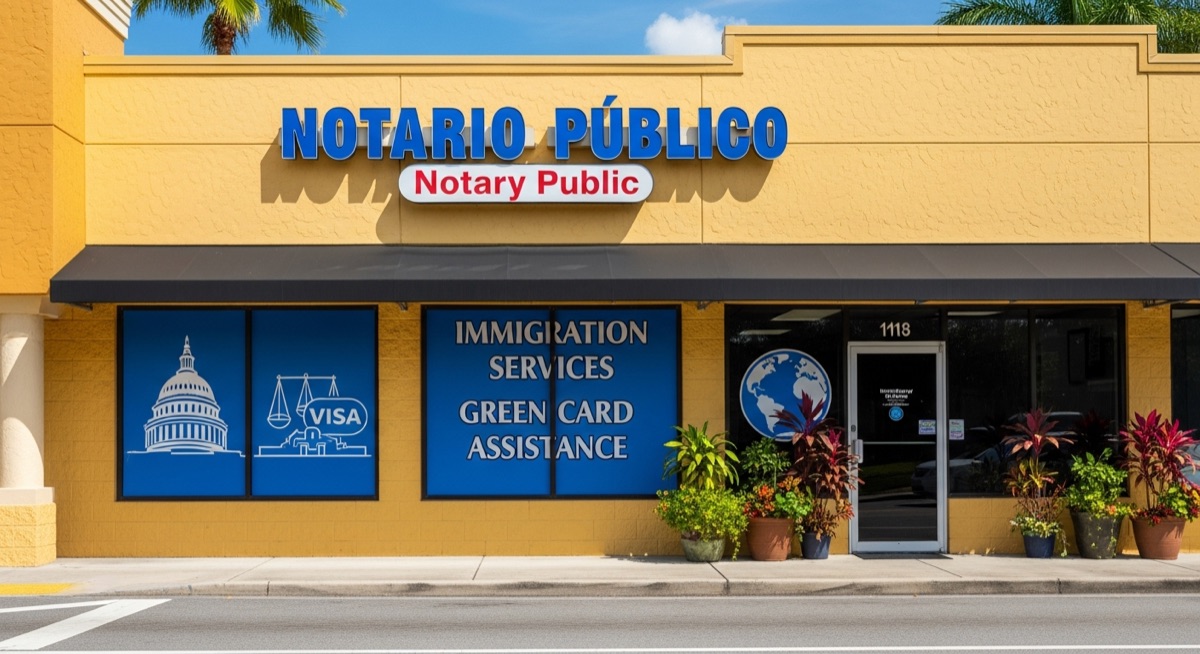
Somewhere on Orange Blossom Trail or Semoran Boulevard, right now, there is a storefront advertising immigration services alongside tax preparation and international wire transfers. The sign may say “notario público.” The person behind the counter may have a notary stamp and a laminated credential on the wall. They cannot legally help you with your immigration case. If they try, they are committing a felony under Florida law. The damage to your case could follow you for years.
This is not a new problem, and it is not small. Orange and Osceola counties together have one of the largest Latino immigrant populations in the American Southeast, concentrated in communities that arrived from Puerto Rico, Mexico, Guatemala, Honduras, El Salvador, and Colombia. The Florida Attorney General’s Consumer Protection Division has received complaints naming Orlando-area immigration consultants. The Florida Bar’s Unlicensed Practice of Law Department pursues cases across this corridor regularly. Notario fraud spikes measurably around DACA renewal deadlines and Temporary Protected Status re-designation announcements — the exact moments when people with the most to lose are most likely to take a shortcut on legal help. That timing is not accidental. It’s predatory.
This guide names names, gives addresses, and tells you what to do whether you’re starting a case or cleaning up after a fraud. It is written specifically for Central Florida.
Why This Problem Is Concentrated Here
The geography is not coincidental. The Orange Blossom Trail corridor from Colonial Drive south through Oak Ridge and Pine Hills, and the Semoran Boulevard corridor from Winter Park south through Azalea Park, have long been commercial centers for Central Florida’s Latino community. The storefronts that serve these neighborhoods legitimately — wire transfer shops, insurance agencies, tax preparers, travel agencies — often share walls or combine services with businesses offering “immigration help.” The bundling itself should make you suspicious.
Osceola County gets less press coverage than the Orange County corridors, but the problem there is just as serious. The US-192 corridor through Kissimmee and the US-441 stretch into Buenaventura Lakes and Poinciana have documented concentrations of unlicensed immigration service businesses. And Kissimmee has a particularly acute version of this problem for a reason that doesn’t get said plainly enough: it has one of the largest concentrations of Puerto Rican residents outside Puerto Rico in the entire Southeast.
Puerto Ricans are United States citizens by birth. They cannot be deported. They don’t need immigration attorneys, green cards, or work authorization. Yet documented cases in Florida show that recently arrived Puerto Ricans — particularly those from communities with limited experience navigating stateside government paperwork — have been charged hundreds of dollars for “immigration consultations,” USCIS forms, and “legal services” they neither needed nor could legally receive. Filing an I-485 application for adjustment of status on behalf of someone who is already a U.S. citizen is not merely a waste of money. In some circumstances it creates paperwork complications that require professional correction. A notario operating in Kissimmee collected $800 from a family of four newly arrived from San Juan for “green card preparation.” No member of that family needed a green card.
The combination of a large and diverse immigrant population, commercial corridors that normalize mixed-service storefronts, and pressure deadlines created by federal immigration policy changes makes Central Florida an unusually concentrated site for this specific fraud.
The Notario Trap: What the Title Means and Why It Doesn’t Mean What It Sounds Like
In Mexico, Guatemala, El Salvador, Honduras, and most of Latin America, a notario público is a legally trained professional — typically someone with a law degree who has passed rigorous additional examinations and been licensed to perform high-level legal functions: drafting contracts, authenticating documents, handling real estate transfers and estates. In those countries, going to a notario for serious legal help makes complete sense. The notario is functionally an attorney with additional credentials.
In Florida, a notary public is something entirely different. Becoming a Florida notary requires completing a basic education course and paying a state filing fee of roughly $39. No law degree. No legal training requirement. A notary public is authorized to administer oaths, witness signatures, and certify copies of documents. That’s it. Clerical work.
A business calling itself “Notario Público” on Semoran Boulevard exploits the gap between what that phrase means to someone who grew up in Guadalajara or San Salvador and what it actually authorizes in Florida. The fraud works because the word carries inherited trust — the weight of the Latin American notario’s legal training — in the mind of someone from a country where that title means something. A newly arrived immigrant who has been stateside for two months sees that sign and sees what they would see at home: a qualified professional. That’s the mechanism. That’s exactly what these businesses are counting on.
What they typically advertise includes I-130 petitions, I-485 applications, DACA renewals, work authorization renewals, and sometimes asylum applications. Fees charged by unlicensed providers are often comparable to what a legitimate attorney charges. You don’t even save money. What you lose instead is the quality of the work.
The specific harm goes well beyond the fee. An incorrectly filed I-485 can result in denial with a finding that triggers bars on reapplication. A missed filing deadline on a DACA renewal — caused by incomplete paperwork from an unlicensed preparer — can mean loss of work authorization and exposure to removal proceedings. An asylum application filed with wrong information, or filed past the one-year deadline without documenting an exception, can constitute a permanent bar. Some of these errors are not recoverable. A bad immigration filing can close off options for good.
What Florida Law Actually Says: The Felony Most People Don’t Know About
Most coverage of notario fraud calls it “illegal” and moves on. The actual legal framework is worth understanding because it changes how you should think about who you’re dealing with — and it’s the kind of case detail we document regularly in our legal & finance coverage.
Under Florida law, providing immigration legal advice for compensation is the practice of law. It doesn’t matter whether the person calls themselves a notario, an immigration consultant, an immigration specialist, or a document preparer. If they’re advising you on which forms to file, how to answer questions, what your legal options are, or what your chances of approval might be — that’s practicing law. Under Florida Statutes §454.23, the unlicensed practice of law is a third-degree felony. Up to five years in prison. Same classification as grand theft or aggravated assault. Not a civil infraction. Not a fine. A felony. Most unlicensed operators don’t advertise this fact.
At the federal level, 8 CFR §292 governs who can represent individuals before USCIS and the immigration courts. Non-attorneys may only assist with immigration cases if they are USCIS-accredited representatives working at a nonprofit organization recognized by USCIS. The storefront on OBT doesn’t qualify. The tax preparer who does immigration on the side doesn’t qualify. Even if they pass money to a paralegal in another state, that arrangement creates no federal authorization.
Two separate Florida enforcement bodies handle these violations. The Florida Attorney General’s Consumer Protection Division investigates notario fraud primarily as a consumer protection violation under Chapter 501 of the Florida Statutes. Filing a complaint here can contribute to civil enforcement actions, injunctions, and restitution orders — the AG’s office has authority to go after the money. The Florida Bar’s Unlicensed Practice of Law Department investigates the same conduct as an illegal practice of law matter. The Bar can pursue cease-and-desist orders and court injunctions, and UPL cases can be referred for criminal prosecution.
File with both. The processes are entirely separate. One does not substitute for the other.
How to Verify Anyone Claiming to Be an Immigration Attorney in Orlando
Go to FloridaBar.org and click “Find a Lawyer.” Search by name or bar number. A licensed attorney in good standing will show an active status, their bar admission date, their current address of record, and any public discipline history. Free. Takes under two minutes. This is the only verification that matters.
If the person you’re considering is not in this database with an active license, they cannot legally represent you in an immigration matter in Florida. Don’t accept an explanation. Don’t pay them more money.
A good result looks like this: the name appears, status reads “The Florida Bar Member in Good Standing,” and the address of record corresponds to an actual law office. A dead end looks like this: the name doesn’t appear, or it appears with a status of “Suspended,” “Disbarred,” or “Deceased.” No gray area.
For nonprofit providers offering legal services, USCIS maintains a separate list of accredited representatives at recognized organizations, available at uscis.gov (search “recognized organizations and accredited representatives”). This list covers the non-attorney staff at legitimate nonprofits — people like the accredited representatives at Catholic Charities of Central Florida — who are legally authorized to handle immigration cases under federal rules. This is not an alternative to bar verification for attorneys; it’s a separate track for a specific category of legal worker at specific types of organizations.
The American Immigration Lawyers Association’s Central Florida chapter maintains a referral network for those with means to pay private counsel. AILA membership requires active bar licensure. But FloridaBar.org first, always.
Free and Low-Cost Legitimate Immigration Legal Help in Orlando
These are the named, verified providers serving Central Florida. Confirm contact information before you travel, as hours and intake processes change.
Catholic Charities of Central Florida, 1771 N. Semoran Blvd., Orlando, FL 32807, is the primary provider of low-cost accredited immigration legal services in Central Florida. Staff includes USCIS-accredited representatives authorized under federal law to handle cases before USCIS. Services include DACA renewals, family-based petitions, naturalization applications, and asylum screening. They serve clients in Orange, Osceola, Seminole, Brevard, and Lake counties — including Kissimmee and Poinciana, which most statewide resource lists quietly omit. Call their main line to confirm current immigration intake scheduling, language availability, and fees. Some services are free; some carry modest administrative charges.
Community Legal Services of Mid-Florida, 122 E. Colonial Drive, Suite 200, Orlando, FL 32801, handles the more complex categories that many providers can’t take: removal defense, VAWA self-petitions, U-visas for crime victims, and Special Immigrant Juvenile Status cases. The Colonial Drive location is accessible by both SunRail and LYNX bus routes, which matters because the USCIS office certainly isn’t (more on that below). Income eligibility is generally around 200% of the federal poverty level — roughly $62,400 for a family of four — but thresholds and current intake capacity should be confirmed directly with the office. CLSMF also serves Osceola County.
The Orange County Bar Association Lawyer Referral Service connects readers above income thresholds with vetted private immigration attorneys. Initial consultations are typically available at a reduced rate. Confirm current immigration panel availability and the consultation fee when you call.
The Florida Bar Lawyer Referral Service, available through FloridaBar.org or by phone, maintains a statewide roster of Bar members who have identified immigration law as a practice area and agreed to the LRS fee structure. Confirm current panel availability before contacting.
USCIS Orlando Field Office, 9403 Tradeport Drive, Orlando, FL 32827. Appointment only — walk-in service is not available for most matters. The Tradeport Drive location is not well served by public transit, which matters more than it should for an office serving communities that heavily depend on LYNX. If you’re relying on the bus, confirm the specific route and connection before making the trip. And one thing worth saying clearly: USCIS staff cannot advise you on your case strategy or which forms to file. That is not their job. Going there does not replace legal advice.
If You’ve Already Paid a Notario: What to Do Right Now
This is the section that competing coverage consistently shortchanges.
If you’ve already given money to an immigration service provider who was not a licensed Florida attorney or a USCIS-accredited representative at a recognized nonprofit, stop all further payments immediately. Do not pay more money in the belief that it will fix the problem or that your previous payment will be lost if you stop. Further payments create further harm.
Gather every document they gave you and every proof of payment — copies of forms they prepared, receipts, contracts or fee agreements, text messages, emails, business cards, advertising materials. Photograph or photocopy everything. Keep the originals somewhere the notario cannot access. This documentation matters for both the complaint process and legal remediation.
Do not allow the notario to retain your original documents. Your passport, visa, prior immigration documents, birth certificates, and marriage certificates belong to you. If they’re being held — a documented tactic used to keep frightened clients from walking away — recovering them may require a demand letter or a small claims action. A legal aid attorney can advise on this specific step.
File a consumer complaint with the Florida Attorney General’s Consumer Protection Division: call 1-866-9-NO-SCAM (1-866-966-7226) or go to myfloridalegal.com. This creates an official record, contributes to potential enforcement action, and in some cases leads to restitution orders. You can file by phone from anywhere. No lawyer required.
File a separate UPL complaint with the Florida Bar’s Unlicensed Practice of Law Department: 1-866-352-0707. Different process, different office, should be filed independently. The Bar can pursue injunctions and refer cases for criminal prosecution. Also no lawyer required to file.
Then consult a legitimate immigration attorney, and treat this as more urgent than the complaints. Filing with the AG and the Bar is important for preventing future fraud and potentially recovering money — but fixing your immigration case is time-critical in a way those processes are not. If an application was filed incorrectly, filed late, or never filed at all, the window for remediation can be narrow. Sometimes measured in weeks. Some Orlando immigration attorneys take UPL victim cases on contingency or reduced fees where there’s documented fraud and a potential fee recovery opportunity. Catholic Charities and CLSMF may also assess the damage to your underlying case.
One thing to be direct about: filing a complaint with the AG or the Florida Bar does not fix your immigration application. Those complaint processes run on entirely different timelines than your immigration case. Reporting the notario and fixing your legal situation require parallel action. Not sequential.
Red Flags on the OBT and Semoran Corridors: A Practical Checklist
These are patterns from notario fraud operations active in Central Florida specifically — not generic national indicators.
“Notario” or “notario público” in signage or advertising is a red flag by definition. The title carries no legal authorization under Florida law. Promises of guaranteed approval or “fast” processing should make you leave immediately. No one can guarantee USCIS approval, and no private service can speed USCIS processing times. Anyone making these claims is either ignorant of how the system works or counting on you not to know. Either way, walk out.
Requests to sign blank forms are a mechanism for fraud. Never do this. Refusal to provide a written fee agreement is a serious warning sign — Florida Bar rules require licensed attorneys to provide written fee agreements above a nominal threshold, and unwillingness to put the arrangement in writing suggests the person knows they’re on shaky ground.
Ask for the Florida Bar number. A licensed attorney knows their bar number the way they know their phone number. An inability or unwillingness to produce it is disqualifying.
A shared desk in the back of a tax prep office, a suite with no legal signage, or a PO box as the only address — these are patterns seen repeatedly in documented fraud operations. A legitimate law practice has an actual office.
Fees that seem implausibly low for complex immigration work deserve scrutiny. Two hundred dollars for a full green card filing or an asylum application signals that either the work won’t be done or it’ll be done badly. Some services, like DACA renewals at reputable nonprofits, do carry genuinely modest fees. The red flag is suspiciously low pricing on inherently high-stakes, labor-intensive filings. Pressure to sign today is also a signal. Legitimate attorneys give clients time to review agreements and ask questions.
The OBT and Semoran corridors contain real lawyers and legitimate nonprofits. The corridors themselves are not the problem — they’re where Orlando’s immigrant communities live and work. But the density of services also makes fraud easier to hide among legitimate providers, which is exactly why diligence matters most there.
A Note on DACA Recipients and Other Time-Sensitive Cases
For Orlando readers in the most legally precarious situations, notario fraud carries the highest stakes.
DACA recipients navigating renewals are working within a program that has been in federal court litigation for years. Renewal windows open and close under court orders. A notario-caused error on a DACA renewal — an incomplete I-821D, wrong supporting documentation, a missed signature — can mean loss of work authorization during the months it takes to detect and fix the error. In the current enforcement environment, that exposure is not theoretical. Catholic Charities of Central Florida and Community Legal Services of Mid-Florida both handle DACA cases. Confirm current intake availability directly with each organization, since capacity changes with funding cycles and staffing.
TPS holders from El Salvador, Honduras, Haiti, Venezuela, and other designated countries face re-designation deadlines with specific filing windows. Missing those windows, or filing with incomplete documentation of continuous physical presence, creates problems that are difficult to reverse. An unlicensed preparer’s partial understanding of country-specific TPS requirements isn’t a minor inconvenience — it can mean a missed deadline or a rejected filing during a window that won’t reopen.
If you’re a DACA recipient or TPS holder who has used an unlicensed provider and suspects errors were made, the remediation path described above applies — with added urgency. Deadlines on motions and appeals are real constraints. You cannot wait for the complaint process to conclude before addressing your underlying case.
For Spanish-language coverage of this issue, both Univision Orlando (WVEN-TV) and Telemundo Orlando (WRDQ) have aired segments on notario fraud in Central Florida. If you’re sharing this guide with a family member more comfortable reading or watching in Spanish, those outlets provide parallel coverage. For Orlando readers navigating other aspects of the healthcare and social services system, free and sliding-scale healthcare in Orlando covers additional low-cost resources available regardless of immigration status.
Editor’s note: Several data points in this guide — including Catholic Charities’ current phone number, intake process, and language availability; CLSMF’s current immigration intake capacity; USCIS Orlando’s current appointment scheduling procedures; the Florida Bar LRS immigration specialty panel’s current status; current OCBA LRS consultation fees; and confirmed LYNX bus routes to Tradeport Drive — are flagged for primary-source verification before publication. Readers should confirm contact details with each organization directly, as intake processes and hours change. Core legal information — the felony classification under §454.23, the 8 CFR §292 federal standard, the FloridaBar.org verification process, and the AG and Florida Bar complaint contacts — has been verified against current Florida statutes and federal regulation.