Best Places to Eat in Orlando During Summer Heat
A neighborhood-by-neighborhood breakdown rated by AC quality, patio storm-proofing, and the timing windows locals actually use.

Best Places to Eat in Orlando During Summer Heat
A neighborhood-by-neighborhood breakdown rated by AC quality, patio storm-proofing, and the timing windows locals actually use.
Summer dining in Orlando is not a casual proposition. By late May, the heat index regularly hits 100°F by noon. By late June, the National Weather Service logs 92 or more thunderstorm days per year for the metro, with the peak window landing squarely between 2 and 5 p.m.—exactly when you might be thinking about a leisurely afternoon patio drink. Add a tourist surge that runs Memorial Day through Labor Day, pushing wait times at International Drive and Disney Springs into the 45-minute-plus range, and summer dining becomes a logistics problem that no amount of enthusiasm for a good Aperol spritz can solve on its own.
Generic “best patios” lists fail Orlando residents because they weren’t written by anyone who’s ever sat under a pergola on an August afternoon when the sky opened up, or tried to get a table on Park Avenue on a summer Saturday at 7 p.m. This guide is organized differently—by what the weather and the calendar actually demand.
The Three Categories That Matter
Every venue here falls into one of three categories. Understanding the distinction tells you more than a star rating.
Blast-Cold Indoors means aggressive air conditioning—not merely present, but cold enough that the dining room feels like a genuine refuge from the parking lot. This matters more than it sounds. Older building stock in neighborhoods like Ivanhoe Village was never designed for commercial AC loads, and plenty of well-regarded restaurants run systems that are visibly struggling by 1 p.m. on a 95-degree day. Price point doesn’t predict this. Some of the best AC in Orlando is in strip-mall builds on Restaurant Row, where the insulation is modern and the landlord runs the system at scale. Not a romantic answer, but the honest one.
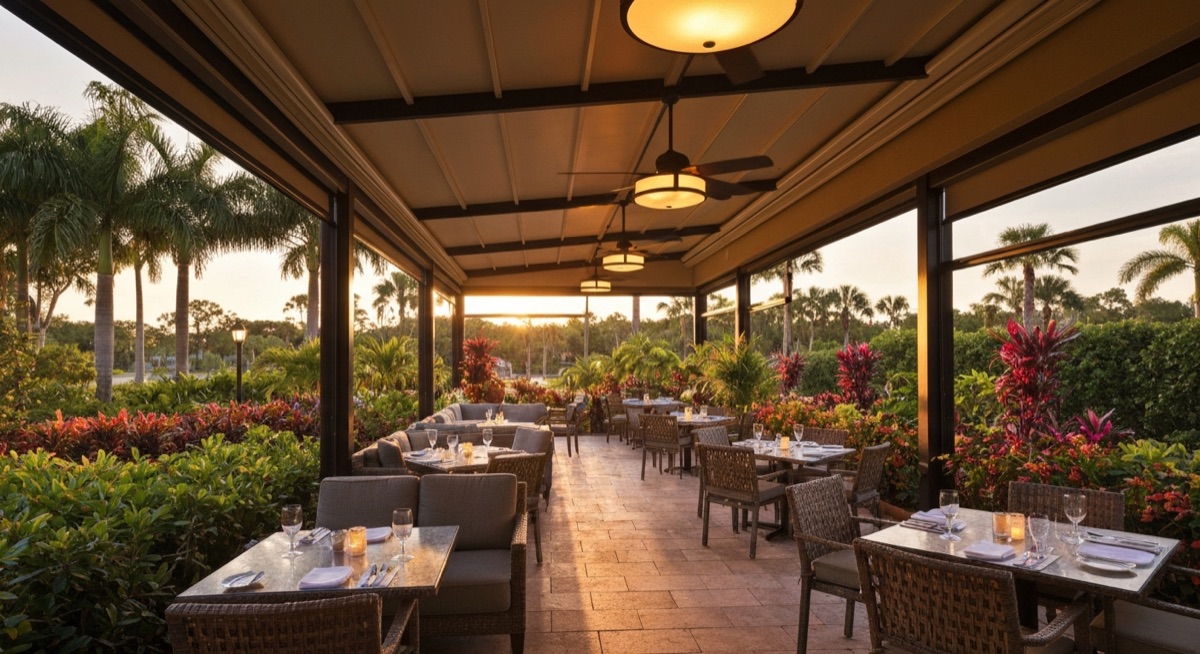
Storm-Proof Covered Patio means infrastructure that holds up to what Orlando actually throws at you: a full permanent roof (not retractable canvas, not a shade sail, not a pergola with gaps), floor drainage capable of handling two inches of rainfall in thirty minutes without puddling under your chair, and roll-down screens or curtains that can contain the space when wind comes with the rain. Misting systems vary. When evaluating a patio, ask whether the system uses high-pressure fine mist or a low-pressure setup—low-pressure produces droplets that add humidity rather than cooling the air. Fan placement matters too. Ceiling fans on a covered patio work only if they’re properly sized for the span and hung low enough to create actual circulation at table level.
Functional Indoor-Outdoor is the middle category: restaurants where inside and outside are close enough together that a fast-moving storm doesn’t ruin the evening. Key details are distance from patio table to indoor seating (under 30 feet is workable; over 60 feet means you’re getting wet during the scramble), whether the indoor overflow area is an actual dining space or a crowded anteroom people stand in while waiting, and whether the staff is practiced at managing the transition without chaos. You can usually read that last one from how a restaurant handles its patio on a busy Friday.
The Timing Framework Locals Use
Orlando’s summer dining calendar runs on a clock most tourists never learn.
11 a.m.–1 p.m. is the lunch window. Heat is building but hasn’t peaked. Thunderstorm development is minimal—the atmosphere needs afternoon heating to destabilize, and that usually takes until early afternoon. This is the one window where an uncovered patio is genuinely viable. Lines at tourist-corridor restaurants are either nonexistent or manageable.
12–4 p.m. is the patio dead zone. By noon the heat index is climbing toward 105°F. By 2 p.m., radar is showing storm cells developing over the interior counties and tracking east. Sitting outside in this window is uncomfortable at best and soaked at worst. Eat inside. No exceptions.
4–6 p.m. is the happy hour sweet spot and, honestly, the smartest move in the Orlando summer playbook. Storms that develop in the afternoon often clear the metro by 6 or 7 p.m. Happy hour pricing is running. Tourist families aren’t yet in circulation for dinner. If you can be flexible, be somewhere with a good bar program, watching the storm move through, paying happy-hour prices. It’s a genuinely pleasant way to spend a Tuesday afternoon if you stop fighting it.
5:30–6:30 p.m. is what experienced Orlando diners treat as the prime summer reservation slot. Storms have typically cleared. The tourist dinner rush—which doesn’t peak until 7 or 7:30—hasn’t arrived yet. On a patio with real coverage, this window is as good as summer gets.
On weekdays, tourist pressure is manageable at most neighborhood restaurants through the full dinner service. Weekends are different: families run earlier, with pressure starting at 5:30 p.m. at popular spots. Book by Tuesday for weekend seatings rather than waiting until the week of. This sounds like overkill until the first time you can’t get a table anywhere reasonable on a Saturday in July.
Blast-Cold Indoor Dining, by Neighborhood
Mills/50 is a neighborhood of mixed advantages. The Vietnamese restaurant cluster along East Colonial benefits from buildings purpose-built for restaurant use—strip-center construction insulates reasonably well compared to the converted-retail spaces scattered through the neighborhood. Newer and recently renovated spots tend to run colder because the renovation work included mechanical upgrades. When evaluating an unfamiliar spot here, stop in at peak-heat midday before committing to a dinner reservation. That visit will tell you more than any review.
Thornton Park is the most variable neighborhood in town for AC reliability, and that’s a diplomatic way to put it. The residential-scale buildings—many of them converted houses—were never designed for the mechanical loads of commercial kitchens and packed dining rooms. A well-maintained system can cope, but it’s working against the building’s envelope the whole time. Ask to be seated away from windows facing west or south, which collect afternoon heat regardless of how hard the AC runs. A warm dining room on a 95-degree afternoon is uncomfortable in a way that ambiance doesn’t fix, and a glass of lukewarm white wine is actively insulting.
Baldwin Park is structurally advantaged, even if the neighborhood feels more planned development than organic dining district. The purpose-built retail construction on New Broad Street has modern insulation and mechanical systems throughout. AC systems here work with the building rather than against it. Less charming than somewhere that grew organically, but on a brutal August afternoon that trade-off is easy to accept.
Winter Park has charm and the inconsistency that comes with age. Park Avenue’s mix of buildings from the 1920s through the 1960s means AC reliability varies significantly by block. Prato runs reliable indoor cooling. Spots in older, thinner-walled buildings can feel warm by mid-afternoon on peak summer days—this isn’t a price-tier issue, it’s a building-era issue, and no renovation budget fully fixes a 1940s Florida envelope in August.
Sand Lake/Dr. Phillips (Restaurant Row) is where strip-mall construction actually works in your favor. Modern commercial buildings along Sand Lake Road have consistent insulation. The format is less charming than a neighborhood dining district, but on a 98-degree afternoon the reliably cold dining rooms here are a genuine asset. This is where you go when cool air matters more than ambiance. There’s no shame in it.
Covered Patios: What to Actually Look For
This is the section most patio guides skip because it requires someone to look at the infrastructure rather than take a press photo. As part of our food & hospitality coverage, we rate patios by infrastructure—not aesthetics.
Is the roof permanent or retractable? A retractable canvas is fine for sun shade. It is not storm protection. A fixed pergola with gaps is neither. You want a full permanent roof—metal, tile, or solid material. If you can’t tell from the outside, ask. Any restaurant that takes its patio seriously will know the answer immediately.
What does the drainage look like? Concrete or pavers with visible drainage channels handle storm volume. Flat pavers with no gradient and no drains will have an inch of standing water under your table within minutes of a serious storm. Walk the patio before you sit. Puddles that show up during a normal rain become small ponds during a summer downpour.
Is there enclosure capability? Roll-down screens or curtains are the difference between a patio you can stay on during a storm and one you have to evacuate. Ask whether they’re motorized or manual, how fast they deploy, and whether they’re actually used during summer storms or just hang there decoratively. That last question gets interesting answers.
Among Orlando restaurants worth investigating for covered patio quality: Seito Sushi in Baldwin Park, Luma on Park in Winter Park, and The Osprey Tavern in Baldwin Park. Each has been flagged by regulars as having meaningful patio infrastructure, but drainage, enclosure capability, and misting system quality should be confirmed on-site—not taken on faith from a review written in October.
Post-pandemic patio expansions deserve skepticism. Restaurants that added outdoor seating in 2020 and 2021 often used temporary structures never intended to be permanent. They frequently don’t drain, can’t be enclosed, and weren’t built for the wind loads that accompany a summer squall line. Some have since been properly built out. Many haven’t, and you can usually tell by looking at the frame materials and how the roof connects to the building. It’s worth asking directly.
Functional Indoor-Outdoor Spots Worth Knowing
Prato (Winter Park) benefits from Park Avenue’s mature oaks, which lower the effective temperature on the street and block western sun in a way that raw temperature data doesn’t capture. The patio is more viable at 6:30 p.m. than the thermometer would suggest—the canopy does real work. Locals who know the street book 5:30 or 6 p.m. rather than trying to walk in at 7 on a Saturday. That gamble rarely pays off.
Osprey Tavern (Baldwin Park) has an indoor-outdoor connection that regulars describe as fast when weather moves in—something you genuinely appreciate when a squall line arrives with four minutes’ notice, which is often exactly how it goes. Baldwin Park also runs lower tourist pressure than Winter Park or downtown, which is its own advantage in summer. Specific enclosure and misting infrastructure requires a field visit to verify, but the neighborhood’s insulation from tourist traffic is consistent.
Thornton Park options benefit from Lake Eola proximity. The lake generates evening breezes that make outdoor dining viable in a way that raw sunset temperatures don’t capture. Spots along Washington Street and Central Boulevard get this thermal assist. Patio sizes here also tend to be small, which means indoor transition during a storm is quick—a practical advantage over larger, more spread-out setups, even if it doesn’t feel like one when you’re booking. A 6 p.m. reservation at a Thornton Park spot is better-timed than the same hour at an exposed patio elsewhere in the city.
Where Not to Go (And When the Tourist Corridors Are Worth It Anyway)
International Drive and Disney Springs, June through Labor Day, during normal dining hours: just don’t. This isn’t a quality judgment on the restaurants. It’s a logistics judgment. Parking structures on I-Drive in July require patience most people don’t budget for. Stand-by waits at Disney Springs on a Saturday evening can run over an hour, and the outdoor waiting areas are exposed and hot. You already knew this.
The narrow exception: a very early weekday lunch—seated by 11:15 a.m.—makes both corridors accessible and manageable. Parking is easy, kitchens are fresh, and the tourist families who drive the waits are still at theme parks. If you have a specific reason to be in either corridor, this is the window.
Park Avenue in Winter Park handles tourist pressure better than I-Drive on most summer days, but Saturday afternoons and Sunday brunches are the real pressure points. The Morse Museum and the general walkability draw significant out-of-town traffic on weekends. If you want Park Avenue on a summer weekend, the 11 a.m. to 12:30 p.m. window or the 6 to 6:30 p.m. first-seating slot are your realistic options. The 7 p.m. walk-in on a Saturday in July is a gamble that frequently ends with a drink at a bar while you wait—which is fine if that’s the plan, but a bad surprise if it isn’t.
What to Check Before You Sit Down on Any Orlando Patio
Ask about the roof before you choose your table. “Do you have a covered patio?” produces wildly variable answers in Orlando. “Is the roof permanent or retractable?” is the follow-up that matters. The distinction is everything between 3 and 6 p.m.
Look at the drainage when you walk through. You can assess this before you order. Flat pavers with no visible gradient and no drains will have standing water under your chair within minutes of a serious storm. Drainage channels or perimeter grating are what you want to see.
After a storm clears, budget for mosquitoes. Near water—Thornton Park near Lake Eola, College Park near Lake Ivanhoe—mosquito activity increases dramatically once rain stops. The post-storm breeze helps, but it’s not a complete solution. Bug spray or an indoor backup plan is the honest answer.
Read the radar, not the sky. The sky can look clear well before a storm arrives—this catches people who’ve lived here for years. On a summer afternoon, check radar specifically before you leave the house. RadarScope or the Weather Channel’s radar layer will show you where cells are and how fast they’re tracking. If you’re booked at a spot with real roof and real drainage, an approaching cell is manageable. If you’re planning an uncovered patio evening, afternoon radar is information you want before you go—not after you’re already there. Understanding heat index and humidity in Orlando summers helps you read those forecasts more accurately.
The Summer Dining Cheat Sheet
Confirm hours and patio specs directly with each restaurant. Seasonal changes are common and third-party listings lag.
Blast-Cold Indoors (Verify AC Quality On-Site)
| Restaurant | Neighborhood | Best Timing Note |
|---|---|---|
| Prato | Winter Park/Park Ave | Early dinner 5:30–6 p.m.; avoid Saturday 7 p.m. walk-in |
| Seito Sushi | Baldwin Park | Book the 5:30 slot; lunch without reservation is workable |
Storm-Proof Covered Patio (Field-Verify Infrastructure)
| Restaurant | Neighborhood | Best Timing Note |
|---|---|---|
| Seito Sushi | Baldwin Park | Confirm enclosure capability; book ahead on weekends |
| Luma on Park | Winter Park | Tree canopy helps; target 6–7 p.m. post-storm window |
Functional Indoor-Outdoor (Verify Transition Setup)
| Restaurant | Neighborhood | Best Timing Note |
|---|---|---|
| Prato | Winter Park | 6–6:30 p.m. first-seating; tree canopy extends evening patio viability |
| Osprey Tavern | Baldwin Park | Lower tourist pressure; book the 5:30 |
Avoid (June–Labor Day, Peak Hours)
| Area | Why | Exception Window |
|---|---|---|
| International Drive | Parking, hour-plus waits, exposed queues in heat | Weekday lunch, seated by 11:15 a.m. |
| Disney Springs | Same problems, plus theme-park crowds | Same narrow window |
| Park Avenue weekends | Tourist pressure 12:30–7 p.m. Saturdays and Sundays | 11 a.m. early lunch or 6–6:30 p.m. first seating |
The 4 p.m. storm isn’t going anywhere. Neither is July. What changes when you’ve lived here long enough is that you stop treating the weather as an obstacle and start building around it—early lunch on a patio, indoors with a drink while the storm moves through, back outside after 6 with whatever breeze is coming off the lake. The restaurants that have built real infrastructure around these conditions are worth knowing by name. The ones that haven’t are worth knowing too, so you’re not standing under a dripping pergola at 4:30 on a Tuesday wondering why you didn’t just ask about the roof.