How to Choose a Sports Medicine Doctor in Orlando
A reported guide to choosing between sports medicine, orthopedic surgery, and your primary care doctor — with local practices, real costs, and wait-time reality for Orlando residents.

How to Choose a Sports Medicine Doctor in Orlando
A reported guide to choosing between sports medicine, orthopedic surgery, and your primary care doctor — with local practices, real costs, and wait-time reality for Orlando residents.
Orlando doesn’t have an off-season. Disney Marathon Weekend sends runners through the roads around EPCOT and Magic Kingdom every January. The USTA National Campus in Lake Nona — the largest tennis facility in the world — draws competitive players year-round. Youth travel baseball cycles through ESPN Wide World of Sports in Osceola County. Cyclists are on the West Orange Trail in December and the Cady Way Trail before work.
And then there’s everyone else. The people playing pickup basketball on weeknights. The guy who twisted something at a CrossFit box on Colonial and is now limping through his week, icing it at night, hoping it resolves.
When something hurts, Orlando offers a crowded menu of options: urgent care chains, hospital-based orthopedic institutes, sports medicine specialists, primary care physicians. For most patients, it’s genuinely not obvious which one they need. The wrong choice wastes time, money, or both.
What a Sports Medicine Doctor Actually Does (and Doesn’t Do)
Start with the credential, because it matters more than the marketing. A sports medicine physician is not simply any doctor who sees athletes. The formal designation requires completing a residency — in family medicine, emergency medicine, internal medicine, pediatrics, or physical medicine and rehabilitation — followed by a separate, competitive one-year sports medicine fellowship. After that, physicians can earn a Certificate of Added Qualification (CAQ) in sports medicine from their respective board. That CAQ is the credential to look for.
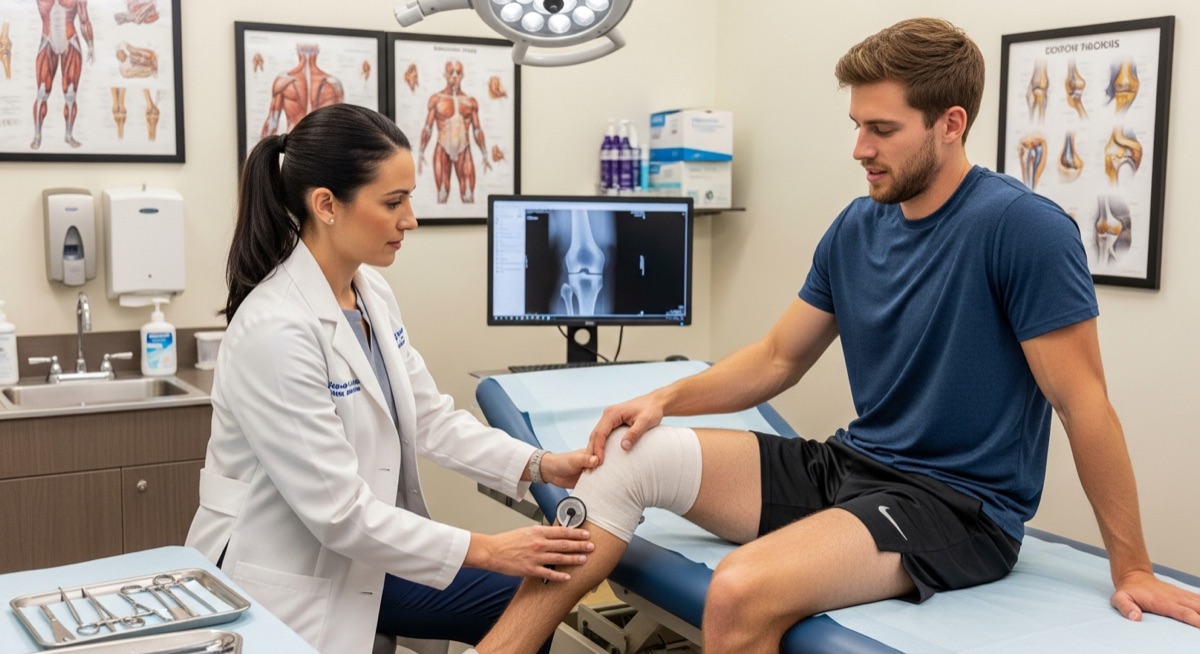
What that training enables: sports medicine physicians can order and interpret MRI, X-ray, and musculoskeletal ultrasound. Many perform diagnostic ultrasound themselves in-office to evaluate tendons, ligaments, and bursae in real time. They administer cortisone injections, platelet-rich plasma (PRP) therapy, and hyaluronic acid injections for joint conditions. They manage concussion protocols, including return-to-learn and return-to-play clearance. They handle exercise-induced asthma, heat illness, and stress fractures.
Surgery is not in scope. Sports medicine physicians are non-surgical by definition. They’re diagnosticians and case managers, and in many situations the person who determines whether a surgical consult is warranted at all. That distinction matters more than it sounds. Seeing an orthopedic surgeon first for an injury that doesn’t require surgery often means paying surgical specialist rates for a consultation that sends you back to conservative care. Sports medicine doctors exist precisely in that gap — between “my PCP doesn’t know what to do with this” and “I need an operation.”
Physical therapists are not sports medicine physicians and can’t diagnose or order imaging. They rehabilitate. Sports medicine doctors diagnose, manage, and decide when PT is the right next step versus when something else is happening. These roles complement each other; they don’t substitute.
You don’t have to be an athlete to see a sports medicine physician. Weekend warriors, office workers with knee pain, older adults with tendinopathy — all within scope. The specialty’s name is honestly misleading. “Musculoskeletal medicine” would be more accurate, but sports medicine is what the credential says.
Sports Medicine vs. Your PCP vs. an Orthopedic Surgeon
Your primary care physician is the right first call for minor injuries. A mild ankle sprain that’s weight-bearing within a day. Muscle soreness after unusual exertion. A minor contusion. PCPs handle basic sprains well and can order X-rays. If you’re established with a PCP who knows you, that relationship has real value — don’t skip it for something that might resolve in a week on its own.
A sports medicine physician makes sense when the diagnosis isn’t clear or the injury isn’t resolving. Stress fractures — common in runners and soccer players — require sports medicine evaluation because they demand specific imaging protocols and load-management strategies that general practitioners don’t routinely deploy. Tendinopathies like Achilles, patellar, and rotator cuff injuries benefit from the injection and rehabilitation protocols sports medicine doctors are trained in. Grade I–II ligament sprains that aren’t healing after two weeks warrant sports medicine evaluation. Concussions require a physician with protocol training, not a general urgent care visit. If your PCP has said “I’m not sure what this is” or “let’s wait another few weeks,” sports medicine is usually the better next step. That’s not a knock on PCPs — it’s just where the referral logic points.
Go directly to an orthopedic surgeon or the ER for problems that are clearly structural. You heard or felt a pop and immediately lost function. A complete ACL or Achilles rupture presents with an audible pop and immediate inability to bear weight. Suspected fracture or dislocation. A locked joint that won’t move. Severe instability that makes basic movement impossible. These are surgical evaluations, and there’s no reason to route through another specialist first. When these things happen, you know it.
MD Now, CareSpot, and similar urgent care chains advertise sports medicine services. They can handle acute minor injuries — lacerations, basic X-rays, fracture splinting. A physician at a walk-in urgent care center is not a fellowship-trained sports medicine specialist, regardless of how the service is marketed. For anything requiring real diagnostic skill, specialist injection, or ongoing management, you want the actual credential.
Orlando’s Major Systems: AdventHealth, Orlando Health Jewett, and UCF Health
AdventHealth Sports Medicine & Orthopedics
AdventHealth’s sports medicine and orthopedic operation anchors to the Orthopedic Institute on Maitland Boulevard, accessible from the I-4/SR-436 interchange — convenient for patients coming from Altamonte Springs, Casselberry, Maitland, and the Winter Park corridor. AdventHealth is the official healthcare partner of the Orlando Magic. Physicians carry board certification with CAQ credentials.
For new patients, the system operates a central scheduling line and online portal. Referral requirements depend on your insurance: PPO patients can typically self-refer; HMO patients need to confirm with their plan before booking. Wait times for routine new patient sports medicine appointments generally run two to four weeks. Verify current availability and referral requirements directly before scheduling — assumptions don’t serve you well here.
Orlando Health Jewett Orthopedic Institute
Jewett is now housed in a major standalone facility near downtown on Hughey Avenue, one of the larger orthopedic hospitals in the Southeast. One thing worth understanding before you call: Jewett houses both orthopedic surgeons and sports medicine physicians within the same system. They are different providers doing different work. When you schedule, specify that you want a sports medicine physician — non-surgical evaluation — rather than an orthopedic surgeon, unless surgery is already on the table. This sounds obvious but it’s a genuinely common point of confusion, and the front desk isn’t always going to volunteer the distinction.
Orlando Health Jewett is the official medical provider for Orlando City SC and Orlando Pride. New patient scheduling works the same as AdventHealth: self-referral is typically available for PPO patients, HMO plans require confirmation. Expect similar wait windows — two to four weeks for a routine new patient slot, potentially faster if you ask specifically for an acute injury appointment.
UCF Health
UCF Health’s primary community clinic sits on Research Parkway in east Orlando — the most accessible institutional option for residents in Waterford Lakes and the Curry Ford Road corridor. Faculty physicians have sports medicine fellowship training and see general community patients.
One important distinction: UCF Health’s community clinic is separate from the UCF Athletics team physician program, which serves UCF varsity athletes and is not a public clinic. If you’re searching online and find references to UCF sports medicine, confirm you’re looking at the community practice, not the athletics department. It’s easy to end up on the wrong page.
UCF Health tends to have better new patient availability than the larger hospital systems. For residents who would otherwise face a significant drive to Maitland or downtown, that matters. Confirm referral requirements and wait times directly.
Independent Practices — Self-Referral and Faster Access
Many independent sports medicine practices in Orlando accept new patients without a PCP referral. Whether that’s available to you depends entirely on your insurance. PPO plans — Florida Blue PPO, Cigna PPO, Aetna PPO — generally carry self-referral rights to specialists, and independent practices can exercise that flexibility. HMO plans, including Florida Blue HMO and Medicaid managed care plans, require a PCP referral regardless of whether the practice is independent or system-affiliated. That requirement lives in your plan, not in the practice.
Independent practices cluster geographically. The Maitland and Altamonte Springs stretch along SR-436 and US-17-92 has several multi-provider groups. The Dr. Phillips and Sand Lake Road area serves the tourist corridor and southwest Orange County. Winter Park and Baldwin Park serve residents in that quadrant. Smaller practices in these areas often schedule faster than the large systems — sometimes by a meaningful margin.
The most practical real-time tool for availability is a live Zocdoc search filtered to sports medicine in the Orlando metro. It surfaces next-available slots, and some independent providers post same-day or next-day openings that don’t appear through other channels. Filter by insurance, check credentials (look for fellowship training and CAQ), and read the office profiles for notes on self-referral policy.
When you call any practice, ask specifically for a new patient acute injury appointment rather than a standard new patient slot. Many sports medicine practices keep separate acute injury availability because they know patients can’t always wait three weeks. These slots often have shorter lead times. Most front desk staff won’t volunteer this unless you ask.
What a First Visit Costs — With and Without Insurance
On a Florida Blue or BCBS PPO plan with an in-network sports medicine physician, expect a specialist copay of roughly $40–$75. Your plan’s Explanation of Benefits determines the actual number. Pull it before you go.
If you have an HMO and see a sports medicine physician without a PCP referral, the visit may process as out-of-network — meaning you could be responsible for the full cost. This isn’t hypothetical. One call to confirm referral requirements before your appointment eliminates that risk.
Without insurance, a new patient sports medicine consultation in Orlando currently runs approximately $150–$300 depending on the practice and complexity. In-office X-ray, if performed at the practice, adds roughly $75–$200. MRI is almost always a separate referral.
Hospital outpatient MRI through AdventHealth or Orlando Health typically runs $400–$900 on a cash-pay basis. Outpatient independent imaging centers — SimonMed operates in the metro, and other freestanding centers are around — often provide the same study for $200–$500, sometimes less. If you’re paying out of pocket for an MRI, call the imaging center directly and ask for the cash-pay price before you schedule. The difference between hospital-based and freestanding imaging in this market can be $300–$500 for the same scan.
Telehealth follow-up, where available, runs approximately $75–$125 for established patients. Useful for reviewing imaging results or adjusting a treatment plan without burning another in-person visit.
Molina Healthcare, Sunshine Health, and Simply Healthcare are the primary managed care organizations in Florida Medicaid. Acceptance varies by practice and changes. If you’re on any of these plans, call the practice directly and confirm they accept your specific plan before booking. The insurer’s online provider directory is notoriously out of date — don’t rely on it alone. Residents navigating Medicaid coverage may also find our reporting on free and sliding-scale healthcare in Orlando useful for understanding what other cost-access options exist alongside specialist care.
Wait Times and How to Get Seen Faster
Large system sports medicine practices — AdventHealth and Jewett — typically run two to four weeks for a routine new patient appointment. Smaller independent practices are often closer to one to two weeks. Zocdoc’s real-time availability surfaces genuine exceptions; some Orlando providers post openings within days.
January and February are the tightest months. Disney Marathon Weekend and the broader runDisney calendar send a wave of post-race runners into local practices every winter. If you’re training for a spring race and have a nagging injury to evaluate, book in November or December. Don’t wait until after you’ve run 26.2 miles on it. This isn’t generic planning advice — it’s the specific dynamic that causes a bottleneck in this market every year. For anyone managing training around Orlando’s climate and race schedule, our Orlando Summer Workout Guide covering safe windows and shaded trails is worth reading alongside this piece.
To get seen faster: ask for the acute injury slot. Ask whether a nurse practitioner or physician assistant can see you sooner. At practices with advanced practice providers on staff, an NP or PA can perform an initial evaluation, order imaging, and start treatment. You can see the supervising physician for follow-up once results are in. For most straightforward injuries this works exactly as well, and it’s faster.
If you have existing imaging from a prior encounter, some sports medicine practices will see you via telehealth to review it and give you a treatment direction. This can cut weeks off the wait, and it’s an option more patients should know to ask about.
Lake Nona and East Orlando
The infrastructure in that corner of the city has shifted substantially in the past five years, and it rarely gets addressed directly in local health & wellness coverage.
Lake Nona Medical City is not a single hospital. It’s a planned medical campus housing four separate institutions: Nemours Children’s Hospital, UF Health Orlando, the UCF College of Medicine, and the VA Medical Center. That concentration of specialist care in southeast Orlando has changed what’s accessible for families on that side of the city.
For youth athletes specifically, Nemours Children’s Hospital is the place to know. Nemours has pediatric sports medicine physicians — trained in the musculoskeletal and physiological differences between developing athletes and adults. Pediatric sports medicine expertise matters: developing athletes present differently and the management protocols differ accordingly. Confirm referral requirements and age parameters directly with Nemours before booking; their intake protocols are specific.
The USTA National Campus sits a short drive from Medical City and generates a steady volume of tennis-related overuse injuries across the metro — shoulder, elbow, and knee conditions associated with high-volume play, at every level of competition. When evaluating a provider for these injuries, it’s worth asking directly whether they see a significant tennis patient population. A provider who treats that volume regularly will have a different intuition about those patterns than one who doesn’t.
UCF Health on Research Parkway is the primary institutional sports medicine option for Waterford Lakes, east Orlando, and the Curry Ford Road corridor. The ESPN Wide World of Sports complex in Osceola County runs youth travel sports tournaments nearly year-round. For families whose kids play travel sports at that facility, knowing that pediatric sports medicine is available at Nemours and adult sports medicine at UCF Health without crossing the metro is useful. Better to know it before something happens.
Quick-Reference Decision Guide
Subacute pain, unclear diagnosis: Start with a sports medicine physician. This is their core use case.
You felt a pop, immediately lost function, or the joint looks wrong: Go to orthopedic surgery or the ER. Not sports medicine first. This one is clear-cut.
Minor injury — mild sprain, muscle soreness, a contusion that’s improving: Your PCP is sufficient and will cost less.
Youth athlete with a concussion: Find a sports medicine physician with formal concussion protocol experience. Nemours and AdventHealth are reasonable starting points. Urgent care is appropriate for initial evaluation of acute symptoms, but concussion management requires follow-up with someone trained in the protocol. That part is not optional.
Cost is the primary constraint: Call practices for cash-pay rates before booking. Ask about the visit fee, in-office imaging, and whether they can refer you to a freestanding imaging center — not hospital outpatient — for any MRI you’re likely to need. Make that call. It can save several hundred dollars on a single scan.
HMO plan: Call your PCP first. Confirm the referral process before scheduling with any specialist. An out-of-plan visit can leave you responsible for the full cost, and the bill arrives after the appointment.
You’re trying to figure out whether you need surgery: See a sports medicine physician first. They’re trained to answer exactly that question and will refer you appropriately if surgery is indicated. Going straight to an orthopedic surgeon for a problem that doesn’t require surgery is a common and expensive detour.
One note that applies to everything above: referral policies, insurance acceptance, and new patient availability change, sometimes faster than any published guide can track. Before any of this, make a five-minute call to the practice’s scheduling line. Confirm they take your insurance, confirm whether you need a referral, and ask what the new patient wait actually looks like right now. That call determines whether your insurer pays and whether the appointment you’re counting on happens at all.