How to Fight HOA Disputes in Florida
From mandatory pre-suit mediation to foreclosure thresholds, here's the process Orange County residents need to know — statute by statute.

How to Fight HOA Disputes in Florida
From mandatory pre-suit mediation to foreclosure thresholds, here’s the process Orange County residents need to know — statute by statute.
Yes, you can fight an HOA fine in Florida. But only if you follow a specific legal sequence that most homeowners don’t know exists. Florida law requires most disputes to go through a mandatory pre-litigation process before you can set foot in a courtroom. Skip that step and your lawsuit gets dismissed. The process differs depending on whether you live in a single-family subdivision or a condominium, and the 2024 reform legislation changed some of the rules. Orange County has no local mediation program, which means if the state process doesn’t resolve your dispute, you’re heading to the 9th Judicial Circuit courthouse at 425 N. Orange Ave.
Here’s what you actually need to know.
Are You in an HOA or a Condo Association? The Answer Changes Everything
Before you send a letter, file a complaint, or call an attorney, you need to know which Florida statute governs your community. Most generic HOA advice skips this entirely. Get it wrong and you’re following the wrong process.
Florida law creates two entirely separate legal tracks. Chapter 720 governs homeowners associations — single-family subdivisions, townhome communities, planned unit developments. Baldwin Park in east Orlando. Hunters Creek in south Orange County. The subdivisions spreading across Lake Nona. Chapter 718 governs condominium associations: the high-rise and mid-rise buildings in downtown Orlando, the SODO corridor, established condo communities throughout the metro.
The distinction isn’t just administrative. The two statutes use different arbitration bodies, different complaint processes, and in some cases different rights. A Baldwin Park homeowner disputing an architectural violation notice is on a completely different legal path than a resident on the 20th floor of a downtown Orlando condo tower challenging a special assessment. Same general situation, entirely different rulebook.
Under Chapter 718, the Florida Department of Business and Professional Regulation’s Division of Florida Condominiums, Timeshares, and Mobile Homes has direct regulatory jurisdiction and arbitration authority over condo disputes. Under Chapter 720, DBPR’s enforcement role was historically narrower. That changed with HB 1203 in 2024, covered below.
If you own a unit in a building where you share structural elements — roof, hallways, exterior walls — with other unit owners, you’re almost certainly under Chapter 718. If you own a lot with a house on it and pay dues to an association that maintains common areas and enforces community rules, you’re almost certainly under Chapter 720. When in doubt, pull your deed and Declaration of Covenants, Conditions, and Restrictions. The governing document will reference the applicable statute.
What Is the Mandatory Dispute Process Before You Can Sue Your HOA in Florida?
Florida law requires most homeowners to exhaust mandatory pre-litigation dispute resolution before filing suit. Skip it and your case gets thrown out. This is the procedural fact most Orange County homeowners learn only after they’ve already made a costly mistake.
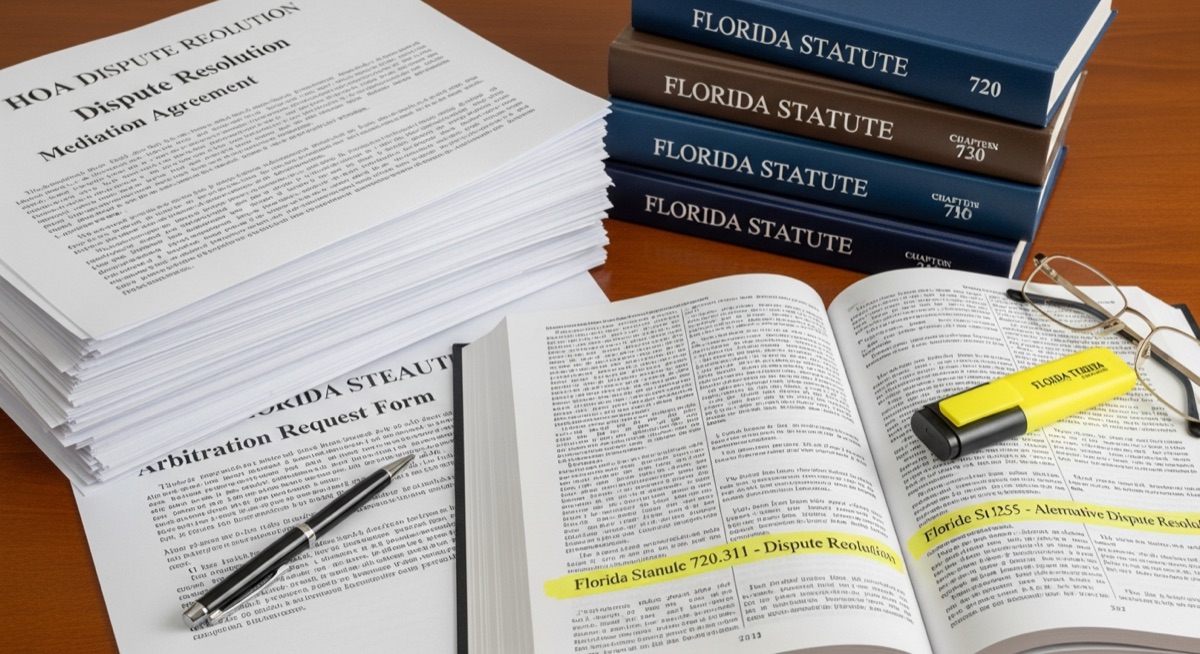
The relevant statutes are §720.311 for HOAs and §718.1255 for condo associations. Both require a pre-suit process before most disputes can reach circuit court, though the mechanics differ. For HOA disputes under §720.311, Florida requires either mandatory non-binding arbitration through DBPR or pre-suit mediation, depending on the nature of the dispute. Disputes involving board authority, owner rights under governing documents, and certain rule enforcement matters go to mandatory DBPR arbitration. Governing document amendments and board member recalls follow separate procedures.
The sequence: before filing with DBPR, the homeowner must serve a written demand for pre-suit mediation or arbitration on the HOA. This is a condition precedent to filing — meaning the court won’t reach the merits of your case if you skipped it. If the HOA doesn’t respond within the required period or mediation fails, the homeowner files a petition for arbitration with DBPR’s Division through myfloridalicense.com. A DBPR arbitrator then reviews written submissions from both sides.
The arbitration is non-binding. The arbitrator issues a decision; either party can reject it and still file in circuit court. It’s a required stop on the way to litigation, not a final resolution. If either party rejects the decision, they file de novo in the 9th Judicial Circuit Court at 425 N. Orange Avenue. The DBPR arbitration record becomes part of the case.
For condo disputes under §718.1255, the process is similar. DBPR has stronger regulatory jurisdiction over condos and a more established arbitration track.
One practical frustration worth naming: because DBPR arbitration is non-binding, an HOA that loses can simply appeal to the courts anyway. The process creates a documented record and sometimes prompts settlement, but it doesn’t guarantee resolution. It’s also genuinely frustrating to complete and then have the HOA ignore the outcome. That’s the process. You have to do it anyway.
Disputes involving imminent harm may not need to wait out the full arbitration timeline — an active foreclosure being one example. Emergency injunctive relief in circuit court remains available in genuine emergencies. This is the one situation where you should call an attorney before filing anything, not after.
Can Your HOA Actually Foreclose on Your Home Over Unpaid Fines?
Yes, Florida HOAs can foreclose on your home. The 2024 reforms added meaningful limits, but the basic authority is real and homeowners routinely underestimate it.
Florida has always allowed HOA foreclosure actions for unpaid assessments — the monthly dues every homeowner agreed to pay at closing. The HOA holds a lien right under Chapter 720 to enforce that obligation. Fines are a different story. Historically, Florida HOAs could not place a lien on your property solely for unpaid fines. A fine for a brown lawn or an unapproved fence couldn’t by itself support a foreclosure action. That distinction remains important. HB 1203 capped fine amounts and tightened procedural requirements, but fines still cannot independently support a lien and foreclosure unless unpaid fines are rolled into an unpaid assessment obligation through a process the governing documents must explicitly authorize.
The foreclosure sequence for assessments is governed by §720.3085, which requires specific written delinquency notices, a recorded lien after required notice procedures, and an opportunity for pre-suit mediation before initiating foreclosure. Foreclosure actions in Orange County are filed in the 9th Judicial Circuit.
The moment you receive a lien notice, do not ignore it. That notice is not a courtesy — it’s the start of a statutory countdown. You have a limited window to pay, dispute the underlying assessment, or negotiate. If you believe the lien is improper — based on fines rather than assessments, or in the wrong amount — you need to act promptly. Contact an attorney. If the underlying dispute falls under §720.311, consider filing for DBPR arbitration. Once litigation starts, costs escalate fast for both sides.
What HOA Records Are You Legally Entitled to Inspect — and What Happens If They Say No?
Under §720.303(5), Florida homeowners have an explicit statutory right to inspect and copy their HOA’s official records. The HOA has ten business days to comply after a written request. This is probably the most underused tool available to Orange County homeowners, and it’s free.
The inspectable records include financial statements and annual budgets, board and member meeting minutes, current contracts and those from the preceding year, insurance policies, and governing documents. Attorney invoices are inspectable too, with one carve-out: the HOA may redact portions subject to attorney-client privilege, but it cannot refuse to produce billing records entirely. Records relating to pending or anticipated litigation fall into the same category, subject to privilege claims.
Submit your request in writing to the HOA board or property manager, specify the records you want, and keep a copy. Send it in a way that creates a delivery record — email with read receipt, certified mail, or hand delivery with written acknowledgment. The HOA has ten business days.
The statute prohibits charging a fee for on-site inspection. In-person inspection at the HOA’s office or management company’s office is free. Reasonable copying fees apply if you want physical copies. Charges that appear designed to discourage access rather than recover actual copying costs are legally suspect, and worth flagging in any subsequent DBPR complaint.
An HOA that willfully fails to provide records within the ten-day window faces damages and attorney’s fees if the matter proceeds to enforcement. The word “willfully” matters — a genuine inadvertent delay may not trigger penalties, but a pattern of stonewalling will.
If you’ve been issued repeated fines and suspect the board isn’t applying them consistently across the community, the records request is your first move. Not DBPR, not a lawyer, not an angry email to the board. Financial statements, minutes, and board contracts will tell you whether you’re dealing with selective enforcement, self-dealing, or straightforward administrative incompetence — and those have different legal implications and different remedies. For broader context on the hidden costs of homeownership decisions in Orlando, including how HOA obligations factor into the buy-versus-rent calculation, see “The Costs That Don’t Show Up in the Calculator”.
How Do You File a Complaint Against Your HOA With the State of Florida?
The DBPR complaint process is the primary state-level enforcement avenue for Orange County residents. Go in with realistic expectations. DBPR is not a general-purpose HOA regulator, and a lot of homeowners file complaints expecting more than the agency can actually deliver.
DBPR has broader direct enforcement jurisdiction over condo associations under Chapter 718 — it can investigate complaints, issue citations, and impose fines on condo associations for statutory violations. For HOA complaints under Chapter 720, DBPR’s historical role was narrower, focused primarily on arbitration rather than direct enforcement. HB 1203 expanded DBPR’s HOA oversight authority in 2024, adding tools to investigate board certification compliance, fine procedures, and record-keeping. But DBPR still isn’t a full-service HOA enforcement agency in the way it is for condos, and that distinction matters.
Before filing, compile documentation: governing documents, all written communications with the HOA or management company, violation notices and fines, proof of payment history, and any records obtained through a §720.303(5) request. A complaint without documentation is much harder for investigators to act on.
Complaints are filed through the DBPR online portal at myfloridalicense.com — navigate to the Division of Florida Condominiums, Timeshares, and Mobile Homes. The form asks for the association’s name and address, the nature of the violation, the relevant statute allegedly violated, and your supporting documentation.
DBPR can investigate, issue citations, impose fines on the association, and issue decisions in arbitration proceedings. It cannot award money damages — that requires circuit court. It cannot compel an HOA to reverse a fine the way a court can through injunction. DBPR is the regulatory enforcement track, not the compensation track. Conflating the two leads to a lot of disappointed homeowners.
Orange County has no county-level HOA mediation or ombudsman program. The Florida HOA Ombudsman operates at the state level through DBPR, primarily as an education and information resource. Not adjudication. If DBPR arbitration doesn’t resolve your dispute and circuit court isn’t practical, your options narrow to private mediation — which requires the HOA’s agreement — or accepting the outcome.
What Did Florida’s 2024 HOA Reform Law Actually Change for Orlando Homeowners?
HB 1203, signed into law in 2024, made significant changes to HOA governance in Florida. Most of what’s actually useful to homeowners in Hunters Creek, Lake Nona, or Windermere has been underreported. In our home & property coverage, this legislation has reshaped how we frame rights and responsibilities for Central Florida residents throughout the year.
Fine procedures tightened considerably. An HOA must provide advance written notice and an opportunity to appear before a fining committee before a fine is levied. That committee must be separate from the board — the board cannot fine homeowners unilaterally. If the HOA skips those procedural steps, the fine is legally challengeable. That’s a more meaningful protection than it sounds, because a lot of boards have been skipping those steps for years.
The law created felony liability for board members who misappropriate HOA funds. A board member who takes, transfers, or misapplies community funds can face felony charges. This provision came directly out of documented HOA financial fraud cases across Florida and represents a real shift in accountability — whether prosecutors actually use it is a separate question.
Board members must now certify within a specified period of election or appointment that they have read the association’s governing documents and completed an approved educational course on Florida HOA law. This creates documentable grounds to challenge board actions taken by members who haven’t complied. HOAs must also provide written receipts for assessment payments within a specified timeframe — addressing a persistent problem where associations claimed homeowners were delinquent despite payments having been made, sometimes as a prelude to improper lien proceedings.
Here’s the honest caveat: the reform’s biggest limitation is enforcement. The felony provision depends on prosecution by the State Attorney’s Office. The board certification requirement exists on paper, but there’s no automated verification system. DBPR’s expanded HOA oversight authority is real, but the agency’s capacity for proactive audits is limited. HB 1203 gives Orlando homeowners better legal arguments and more specific procedural grounds to challenge HOA overreach. It didn’t install a referee. The actual enforcement of those arguments still largely depends on individual homeowners raising them — often with legal help.
What Are Orlando HOA Attorneys Actually Seeing Right Now?
The disputes landing in Central Florida HOA attorneys’ offices in 2024 and into 2025 reflect the region’s specific growth pattern: rapid development in Lake Nona and Horizon West, complex layered governance in older master-planned communities like Hunters Creek, architectural review fights in established Windermere and Dr. Phillips neighborhoods.
Architectural review disputes are a consistent high-volume category in the Orlando market. In Windermere and Dr. Phillips, these frequently involve solar panel installations, fence materials, and exterior paint colors. Homeowners made changes after receiving what they believed was oral or informal board approval, then faced fines or removal orders after a board composition change. The recurring legal issue is whether the architectural review committee followed its own published procedures. An HOA that doesn’t follow its own procedures is on weak legal footing, and DBPR arbitration is a relatively efficient venue to raise that argument.
Hunters Creek presents a different complexity. The community operates with a master association and multiple sub-associations, meaning a homeowner can simultaneously be subject to rules and fees from two governing bodies with potentially conflicting authority. Disputes over which association has jurisdiction over a specific common area, who’s responsible for a maintenance obligation, or how fees are properly allocated between master and sub-association dues are fact-intensive and usually can’t be resolved without reviewing multiple sets of governing documents. These are among the more expensive disputes to litigate — and the category where early attorney involvement most clearly pays for itself.
Lake Nona governance issues reflect the challenge of communities where HOA structures were established by developers who retained significant control long after residents moved in. Homeowners in some newer Lake Nona communities have encountered boards still operating under developer-era rules after legally required transition periods had passed. That’s exactly the kind of thing HB 1203’s board certification requirement was meant to address, at least partially.
Firms with active community association practices in the Orlando area include Arias Bosinger and Becker & Poliakoff’s Orlando office, which represent both homeowners and associations.
The consistent advice from attorneys across all dispute categories: document everything in writing before escalating. An email to the board beats a phone call. A formal written records request beats asking a board member in the driveway. A DBPR arbitration petition, even one that ultimately doesn’t resolve the dispute, creates a formal record that changes the negotiating dynamic.
What Does This Process Cost — and Is It Worth It Before Calling a Lawyer?
Most homeowners ask this last. They should ask it first.
DBPR arbitration filing is the cheapest formal entry point into dispute resolution and is generally worth the investment for disputes involving documented procedural violations — an improperly noticed fine, a denied records request, a board action that contradicted the governing documents. For a dispute headed toward DBPR arbitration, a homeowner can often prepare a competent petition after a single attorney consultation to review the governing documents and specific facts. One session is usually money well spent.
When DBPR or a court orders mediation, Florida law generally splits the mediator’s fees equally between the parties unless a court orders otherwise.
Call an attorney before doing anything else if you’ve received a lien notice or any suggestion that foreclosure is being considered. No exceptions. An attorney is also the right call if the financial dispute is substantial, if you’ve been denied records access and the HOA hasn’t responded to a second written demand, or if you’re in a layered HOA structure and the dispute involves which entity actually has authority.
For fine disputes involving clear procedural violations — no proper notice, no fining committee hearing — the DBPR track makes sense on its own. Records access denials with a clear paper trail are another solid case for DBPR. So are governance disputes where you want a formal record created before negotiating.
For fine disputes below the Florida small claims jurisdictional limit, small claims court in Orange County is a potential option after completing the mandatory pre-suit process under §720.311. Small claims is at the Orange County Courthouse, 425 N. Orange Ave. You cannot skip DBPR arbitration and go directly to small claims. That’s the step people keep trying to skip. It doesn’t work.
Sidebar: Florida HOA Law at a Glance — Key Statutes and Resources for Orange County Homeowners
Governing statutes:
- Chapter 720, Florida Statutes — Homeowners Associations (single-family, townhome, planned communities)
- Chapter 718, Florida Statutes — Condominium Associations
- §720.303(5) — HOA official records access rights and penalties
- §720.311 — Mandatory pre-suit dispute resolution for HOA disputes
- §720.3085 — Assessment collection, lien procedures, and foreclosure requirements
- §718.1255 — Mandatory arbitration for condominium disputes
- HB 1203 (2024) — Florida HOA reform legislation (fine caps, board certification, financial fraud provisions)
State agency:
- Florida Department of Business and Professional Regulation (DBPR)
- Division of Florida Condominiums, Timeshares, and Mobile Homes
- Filing portal and complaint submission: myfloridalicense.com
Orange County court:
- 9th Judicial Circuit Court — 425 N. Orange Avenue, Orlando, FL 32801
- Foreclosure actions, post-arbitration circuit court filings, small claims
Local legal resources:
- Arias Bosinger — Orlando-area community association law
- Becker & Poliakoff — Orlando office, community association practice
Florida HOA Ombudsman: State-level resource and education function through DBPR. Not an adjudicative body. Available for general guidance before initiating formal proceedings.
This article reflects Florida law as of 2024–2025 and is intended as general legal information for Orange County residents, not as legal advice for any specific dispute. Specific dollar figures, fee amounts, and penalty thresholds referenced in this article should be confirmed against current Florida Statutes and current DBPR fee schedules before being relied upon. Homeowners facing HOA foreclosure, lien actions, or complex governance disputes should consult a licensed Florida attorney.