How to Get a Pool Permit in Orange County: Costs and Wait Times
If you've been searching "pool permit Orlando" and landing on pages that don't match your actual situation, there's a reason. The permit process for a residential in-ground pool in this region runs…

If you’ve been searching “pool permit Orlando” and landing on pages that don’t match your actual situation, there’s a reason. The permit process for a residential in-ground pool in this region runs through two entirely separate government systems depending on where your house sits. The wrong starting point costs real time — not just a few hours, but potentially weeks.
Orange County Building Division documentation and contractors working in the market will tell you directly: the fee total surprises most first-time applicants. The most common delays are entirely preventable with the right submittal package. This article covers all of it, in order.
Section 1: First, Figure Out Which Department You’re Actually Dealing With
The City of Orlando and Orange County are not the same permitting authority. This trips people up constantly, and honestly, it makes sense that it would — the branding is confusing, the geography isn’t intuitive, and most search results aren’t careful about the distinction. If your property is within the incorporated City of Orlando — generally the area bounded by the Hwy 50/Colonial Drive corridor, the I-4 corridor, and extending into some Winter Park and College Park borders — your pool permit goes through the City of Orlando’s Building and Permitting Services division, not the county. City permits are handled through a separate portal and a separate fee schedule entirely.
If your property is in unincorporated Orange County, you’re in different territory. Unincorporated areas cover a large swath of the metro: Windermere, Dr. Phillips, Hunter’s Creek, Avalon Park, Conway, Pine Hills, Meadow Woods, and Horizon West. Everything in this article applies to you directly.
Before you do anything else, use Orange County’s parcel lookup tool to search your address. Or call the Orange County Building Division at (407) 836-5550 to confirm your jurisdiction. If your property is in unincorporated Orange County, proceed here. If it shows City of Orlando, head to orlando.gov and navigate to their building and permit services portal instead. This one step, done first, will save you significant frustration later.
Section 2: How Long Is the Wait Right Now — And When to Submit to Beat the Backlog
The direct answer: Orange County Building Division residential pool permits go through a multi-trade review queue. The pool permit triggers separate reviews in the CSS (Citizen Self-Service) portal from building, zoning, electrical, and plumbing disciplines. Your permit doesn’t move forward until all have signed off or issued their comments. A correction from any one discipline restarts that trade’s review cycle, adding meaningful time to your total wait.
For current processing times, call the Orange County Building Division directly at (407) 836-5550 before planning your project schedule. Published review windows and real-world timelines in active construction seasons have differed significantly — and I’d be doing you a disservice by printing a specific number here that might already be outdated by the time you read it. The only reliable figure is the one the division quotes at time of your call. You can check current queue depth and review status for active permits through the CSS portal at permits.ocfl.net.
The seasonal pattern is real. Contractors in the market consistently report it. Submittals that come in during October through January move faster. The February through May surge drives a review backlog that compounds week by week. This is driven by residents who decide over winter they want a pool for summer — which, fair enough, but the math doesn’t work out for them. If you’re reading this in the fall and thinking about a pool, submit now. If you’re reading this in March, plan for the slower track.
Section 3: What a Pool Permit Actually Costs in Orange County
The permit fee is not a single number. It’s an assemblage of line items across multiple categories, and the total for a standard residential in-ground pool typically lands in the $700 to $1,200 range before contractor fees. That’s without the screen enclosure, which carries its own separate fee, covered in Section 5. As part of our home & property coverage, we’ve found that permit costs are consistently among the most misunderstood line items in any major home project budget.
Building permit fee: Calculated based on the declared construction value of the pool. Orange County uses a valuation-based sliding scale. For a typical gunite or poured-concrete in-ground pool in the $45,000–$65,000 construction value range, the building permit fee itself generally falls in the $400 to $700 range.
Plan review fee: Typically calculated as a percentage of the building permit fee. Orange County charges a plan review fee that runs approximately 50% of the base building permit fee for residential projects. Expect $200 to $350.
Zoning review fee: Assessed separately for the zoning discipline review. This is generally a flat or modest sliding fee in the $50 to $150 range depending on project type.
Electrical and plumbing sub-permits: Pool electrical — bonding, lighting, equipment circuits — requires its own sub-permit, typically $75 to $150. Pool plumbing, including return lines, drains, and equipment connections, carries a separate sub-permit fee, similarly in the $75 to $150 range.
State and county surcharges: Florida law requires a surcharge on building permits, approximately 1.5% of the permit fee. Orange County assesses additional infrastructure fees that vary by project type and district.
The complete, current fee schedule is published by Orange County Building Division and accessible from the Building Division page at ocfl.net/Building. Pull that document before budgeting. Fees are updated periodically by Board of County Commissioners resolution, and the PDF is the authoritative source — not this article, not your neighbor’s experience from two years ago.
Section 4: The Documents You Need Before You Hit Submit
Orange County requires a specific package of documents for a residential pool permit application. Submitting an incomplete package is the single most reliable way to add time to your timeline. Reviewers will reject or comment on incomplete submittals. Every resubmittal cycle costs time. There’s no workaround here.
Signed and sealed construction plans must be prepared by a Florida-licensed engineer or a pool contractor holding a General Pool/Spa Contractor license, and must bear their seal, signature, and license number. Plans must include pool shell dimensions, depth gradients, steel reinforcement layout, equipment pad location and setbacks, a proposed electrical panel and bonding diagram, and deck and coping detail. Generic plans from a manufacturer are not sufficient. They must be site-specific or adapted to your site conditions. Reviewers notice the difference, and they flag it.
A current site plan with setbacks labeled, based on a survey showing the pool’s location relative to all property lines, existing structures, utility easements, and right-of-ways. Orange County requires labeled setback dimensions on the plan, not just a sketch. Check your specific zoning district, as setbacks vary.
Contractor license and insurance documentation from the licensed pool contractor — current Florida contractor’s license, proof of general liability insurance, and workers’ compensation insurance, or an exemption certificate if applicable. All documentation must be current at time of submittal.
Pool barrier compliance plan. This one catches people off guard. Florida Statute 515 requires that a residential pool be enclosed by a barrier meeting specific height, gate latch, and climb-resistance specifications before the pool can be filled with water. Your submittal must include a pool barrier compliance plan showing how you’ll meet this requirement. Whether through a pool cage, a fence, door alarms, or a combination, include specific hardware callouts and dimensions. Vague plans come back with comments. Specific plans don’t.
Contractors recommend preparing the Notice of Commencement in advance so it can be executed and recorded immediately upon permit issuance.
Section 5: Yes, Your Screen Enclosure Needs Its Own Permit — Here’s How to Handle It
A pool cage or screen enclosure is not included in the pool permit. It’s a separate structural permit with its own plan set, its own review sequence, and its own fee. This surprises a lot of homeowners who reasonably assume the enclosure is just part of the pool project. It isn’t.
The enclosure permit requires PE-sealed wind-load calculations and structural drawings prepared by a Florida-licensed engineer. These must demonstrate compliance with Florida Building Code wind requirements for Orange County. The county’s design wind speed requirement is 130 mph per ASCE 7 — this isn’t a formality, it’s a real structural standard, and plans that don’t address it get flagged. Enclosure plans must show foundation details, framing specifications, and connection details that meet this standard. The enclosure permit fee follows the same valuation-based structure as the pool permit. Expect an additional $200 to $500 in permit fees for the enclosure.
Here’s the part that actually saves you time: Orange County allows concurrent submission of the pool permit and screen enclosure permit. File them together. Both go into the CSS portal. Both enter the review queue simultaneously, and both can be approved without one waiting on the other. Contractors who have optimized their workflow submit both at once and avoid a second full wait cycle compared to submitting the enclosure permit after pool permit issuance. If your contractor isn’t doing this automatically, ask why.
Build this into your project schedule: the barrier statute requires the barrier — whether enclosure or fence — to be in place and inspected before the pool can be filled.
Section 6: What Is Actually Slowing Approvals
The gap between Orange County’s stated review window and real-world permit timelines has a few consistent explanations among contractors working the market.
The most consistent friction point is incomplete pool barrier compliance plans. Florida Statute 515’s barrier requirements are detailed, and reviewers flag them regularly when applicants submit generic or vague barrier plans. A plan that says “fence to be installed” without showing gate specifications, latch height, and self-closing hardware detail will come back with comments, triggering another review cycle. This is probably the most avoidable delay in the entire process.
Setback calculations on site plans are another major correction trigger. Orange County’s plan reviewers check labeled setback dimensions against your zoning district’s requirements. They check utility easements. Plans that show the pool location without explicitly labeling all setback distances — or that show the pool or equipment pad encroaching on a utility easement — generate correction comments that require a revised site plan. It sounds like a small thing until it adds three weeks to your timeline.
Third, and specific to certain parts of Orange County: high-water-table conditions in areas including Dr. Phillips, Horizon West, areas near Lake Nona wetland buffers, and Conway lakefront neighborhoods can require geotechnical review or dewatering plans that affect pool structural design. If you’re in one of these areas, ask your pool engineer whether a soil boring before plan submittal is warranted. Addressing the geotechnical question upfront prevents a correction that sends you back to the start of a review cycle. Worth the conversation before you submit anything.
What a clean, fast submittal looks like, according to contractors who track their own approval rates: sealed and site-specific structural plans, a barrier plan with specific hardware callouts and dimensions, a survey-based site plan with every setback dimension labeled, and all contractor documentation uploaded and current. For applicable lots, include geotechnical documentation at first submission. Submittals that hit all of those marks move through the queue measurably faster.
Section 7: The Inspection Sequence — What Has to Happen Before Your Pool Can Fill
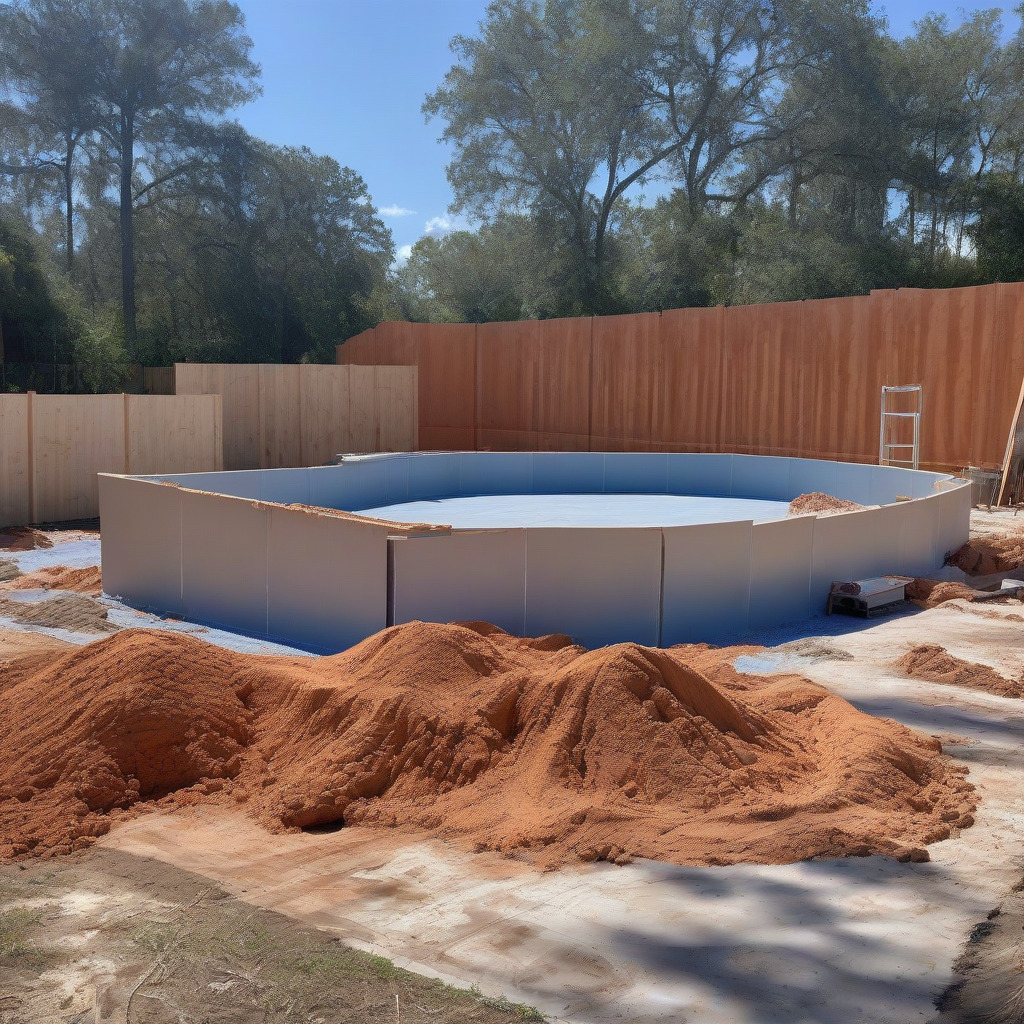
Once your permit is issued and work begins, a residential pool in Orange County goes through a defined inspection sequence. The standard stages proceed as follows: footer and excavation inspection after the pool shell is excavated and steel is placed but before concrete is poured; pre-pour inspection covering plumbing rough-in, electrical bonding, and rebar verification; gunite or shotcrete inspection of the structural shell before plastering; plumbing top-out after shell completion; and electrical rough covering bonding wire and equipment panel connections.
After these structural inspections comes the pool barrier inspection. This is the statutory fill blocker, and it’s non-negotiable. Under Florida Statute 515, a residential pool cannot be filled with water until the required barrier is inspected and approved. It doesn’t matter if the pool shell is complete and ready. If the barrier hasn’t passed inspection, the pool cannot be filled. Period. Build this into your timeline explicitly — homeowners and contractors frequently underestimate the impact of this requirement on project schedules, and it’s a painful lesson to learn when you’re staring at a finished shell in July.
Screen enclosure inspections, if applicable, have their own sequence — typically a rough frame inspection and a final — which must be completed before the enclosure is considered complete for certificate purposes. Final inspection covers the completed pool, all equipment, electrical final, plumbing final, and all required documentation. Issuance of the final certificate of completion closes the permit.
Each inspection must be scheduled through the Orange County Building Division inspection scheduling system, accessible through the CSS portal at permits.ocfl.net. Factor inspection lead times into your project schedule. Don’t assume same-day availability.
Section 8: How to Apply — Step by Step Through the CSS Portal
The Orange County Building Division processes residential pool permit applications through the Citizen Self-Service portal at permits.ocfl.net. If your contractor is pulling the permit on your behalf — which is the standard arrangement — your contractor will have their own contractor account. Confirm with your contractor who is submitting and who will be the permit of record. Get that answer in writing before anything else happens.
Navigate to “Apply for a Permit” and select the residential pool permit type. If you’re filing the screen enclosure at the same time (and you should be), start a separate application for the enclosure simultaneously. Complete the project information form with the property address, parcel ID, project description, declared construction value, and contractor information. Accuracy here matters. Discrepancies between the application and uploaded documents are a common cause of intake rejection — the kind of avoidable delay that stings because it means starting over before a reviewer even looks at your plans.
Upload each required document in the categories the portal provides: construction plans, site plan, contractor license, insurance certificates, and barrier compliance plan. After submittal, the portal will calculate and present the initial fees. Payment is made online at submittal.
After intake review confirms your submittal is complete, the application enters the multi-trade review queue. You can track each reviewer’s status independently in the CSS portal. Building, zoning, electrical, and plumbing each have their own status line. When a discipline issues comments, you’ll receive notification and can view the specific correction items. Resubmit corrected documents in the same portal. When all disciplines have approved, the permit is issued. Your contractor can print the permit card. Before any work begins, the Notice of Commencement must be recorded with the Orange County Clerk of Courts and posted at the job site.
For in-person questions, Orange County Building Division is located at 201 S. Rosalind Ave., Orlando, FL 32801. Phone: (407) 836-5550. Confirm current counter hours on the county website before making the trip — hours have shifted over the past few years and the website is more reliable than memory.
The pool permit process in Orange County is navigable. It’s a defined sequence with published requirements and a clear fee structure — it’s not fun, but it’s knowable. The contractors who move through it fastest submit complete packages. They understand that review timelines apply to clean submittals only. They plan their projects around the inspection sequence rather than working around it. For most homeowners, the most valuable thing you can do before submitting anything is to confirm your jurisdiction, pull the current fee schedule PDF from ocfl.net/Building, call the Building Division at (407) 836-5550 to get the current processing time, and have a direct conversation with your contractor about what a complete first-cycle submittal looks like for your specific lot. That last conversation, more than anything else, is what separates a smooth permit from a three-round correction cycle.
CityDesk Orlando covers local government, business, and development in the Orlando metro. Tips and corrections: [editorial contact].